26 Secant-Ogive-Cylinder — Static and Magnus Aerodynamic Coefficients
Static and Magnus (spin-induced side force) coefficients at Mach 3 against BRL supersonic wind-tunnel data
26.1 Run Provenance and Artifacts
| Item | Value |
|---|---|
| Wake CFD baseline version | 0.22.1 |
| Solver | DBNS |
| Compute device | GPU (NVIDIA RTX A6000) |
| Parallel execution | 1 MPI rank |
| Arithmetic precision | FP64 |
| Run date | 2026-09-21 |
Results depend on the solver build that produced them. Read every figure in this report together with the version and date above — re-running the same input on a later build may give different numbers.
26.1.1 Downloadable Files
Not available: standalone input decks and solver result files have not yet been published for download.
26.2 Validation Objective
This case computes both static aerodynamic coefficients (normal force, pitching moment, axial force) and Magnus (spin-induced side force) coefficients for a secant-ogive-cylinder (SOC) projectile shape, and compares both against a single BRL supersonic wind-tunnel dataset that reports both quantities for the same model. It validates Wake CFD’s rotating-wall boundary condition (motion.type: rotating) against experimental Magnus data — the first such comparison in this report — using the static-coefficient agreement as a supporting check on mesh and numerical setup.
26.3 Reference Solution and Data
| Item | Setting |
|---|---|
| Reference | Nietubicz and Opalka (1980), BRL Memorandum Report ARBRL-MR-02991 |
26.4 Simulation Conditions
| Item | Setting |
|---|---|
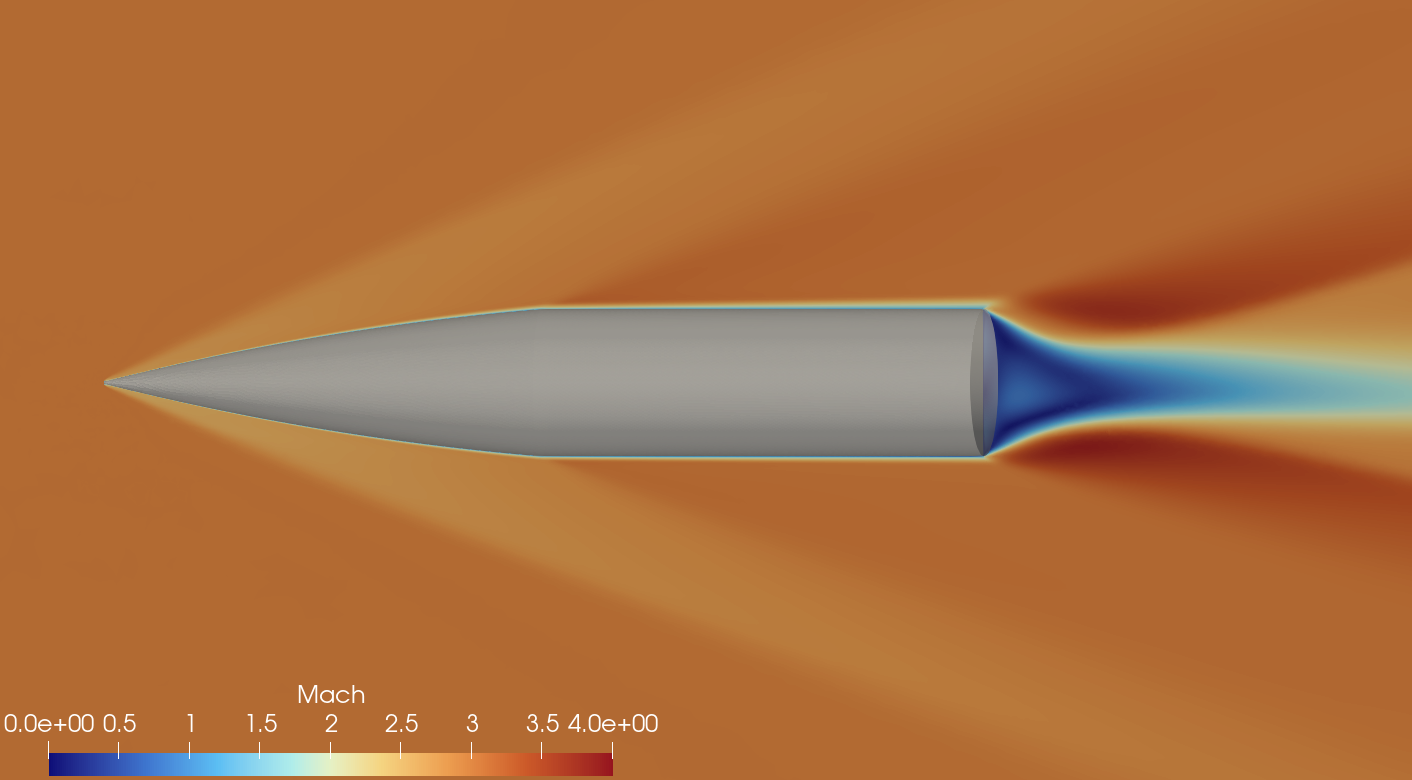
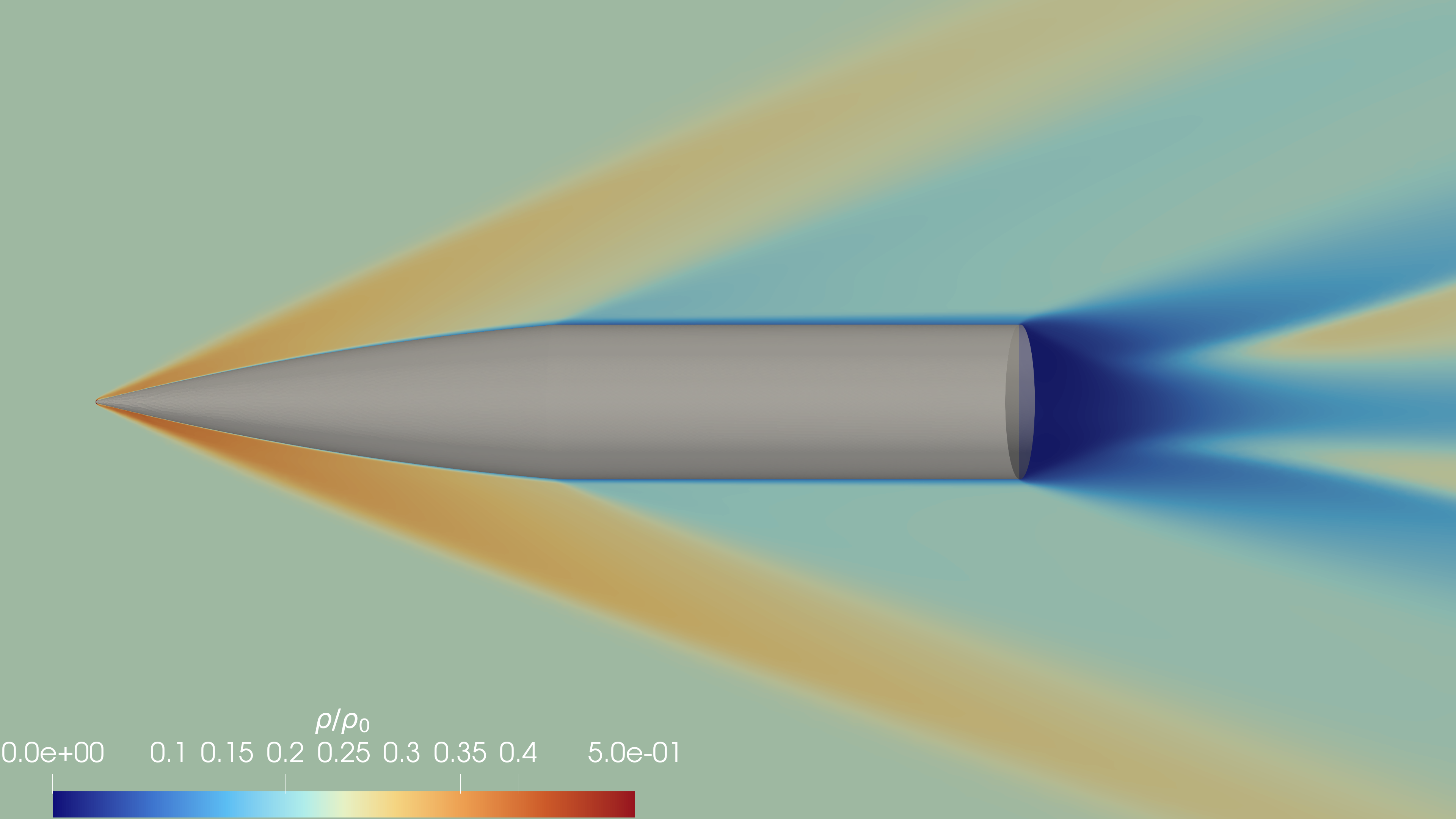
| Geometry | Secant-ogive-cylinder (SOC), 6 calibers long (3-caliber secant ogive + 3-caliber cylinder), no boat-tail, flat sharp-cornered base; reference diameter d = 57.15 mm |
| Analysis | Steady, compressible DBNS, RANS (Spalart–Allmaras) |
| Mach | 3.0 |
Re_L (body length) |
7.22×10⁶ (freestream conditions from isentropic expansion of the tunnel stagnation state) |
| Angle of attack | 0° to 10° (static sweep, 6 points) |
Spin rate Pd/V |
up to 0.4 (Magnus sweep; ω ≈ 2215 rad/s at Pd/V=0.2) |
| Nose tip | Blunted to R_n = 0.5 mm (0.87% of caliber) — the experimental model has a mathematically sharp secant-ogive tip, which cannot be meshed directly; this blunting radius is conservative relative to published precedent for similar shapes |
26.5 Mesh
| Item | Setting |
|---|---|
| Mesh | Unstructured tetrahedral + prism boundary layer, ≈12.9M cells, 2.7 µm first cell height (y⁺ ≈ 0.4 average on the cylinder) |
26.6 Boundary and Initial Conditions
| Item | Setting |
|---|---|
| Wall | No-slip, fully turbulent (no boundary-layer trip modeled) |
Initial field: Not reported.
26.7 Numerical Methods
| Item | Setting |
|---|---|
| Convective scheme | AUSM+-up2, 2nd order (Green–Gauss gradients, Venkatakrishnan limiter, coeff=0.01) |
| Time integration | Implicit, CFL schedule (low-CFL start, ramped) |
26.8 Results
26.8.1 Static Coefficients
Mach 3, angle-of-attack sweep, compared against Table III of the reference (linear range) and digitized figure data (α≥4°):
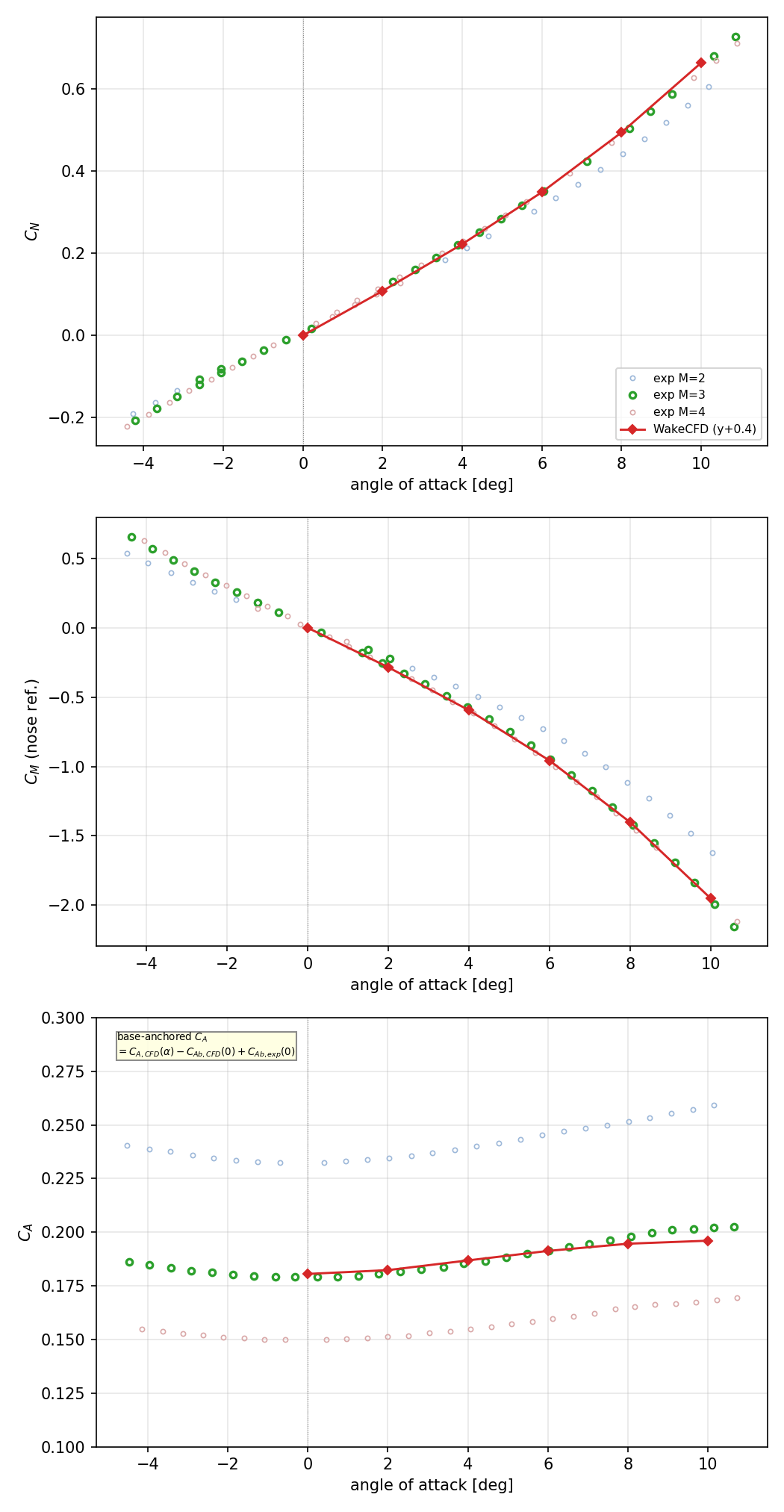
C_N, C_M) versus angle of attack, CFD versus experimentα |
C_N |
Error | C_M |
Error |
|---|---|---|---|---|
| 0° | 0.0000 | — | 0.0000 | — |
| 2° | 0.1083 | +0.4% | −0.2849 | +1.0% |
| 4° | 0.2224 | −1.9% | −0.5944 | +3.1% |
| 6° | 0.3490 | +0.0% | −0.9572 | +1.7% |
| 8° | 0.4945 | +1.2% | −1.4018 | −0.0% |
| 10° | 0.6642 | +1.9% | −1.9514 | −0.7% |
Normal force and pitching moment agree with the experiment within 3.1% across the full 0°–10° range. Axial force comparison is complicated by base-flow contamination in the experimental setup (a balance-strut assembly and spin-drive turbine exhaust are present behind the model, so the reported experimental base pressure is not a free-flight value) — anchoring the CFD forebody-plus-base axial force to the experimental base-pressure level at α=0° and tracking the CFD’s own base-pressure variation with angle of attack gives agreement within 3% across the sweep; comparing against the experiment with a naive constant-base-pressure assumption instead produces a spurious 5.8% error at α=6°, which is an artifact of that assumption rather than a modeling error.
26.8.2 Magnus Coefficients
Mach 3, Pd/V = 0.2, compared against Table IV of the reference (transcribed, not digitized):
α |
C_Yp error |
C_np error |
CPY (CFD / experiment) |
|---|---|---|---|
| 1° | +8.5% | −1.2% | 4.54 / 5.25 |
| 2° | +6.0% | −2.4% | 4.56 / 4.86 |
| 4° | −1.3% | −7.3% | 4.61 / 4.96 |
| 6° | −1.7% | −7.3% | 4.68 / 5.02 |
| 10° | +19.6% | +18.6% | 4.73 / 4.77 |
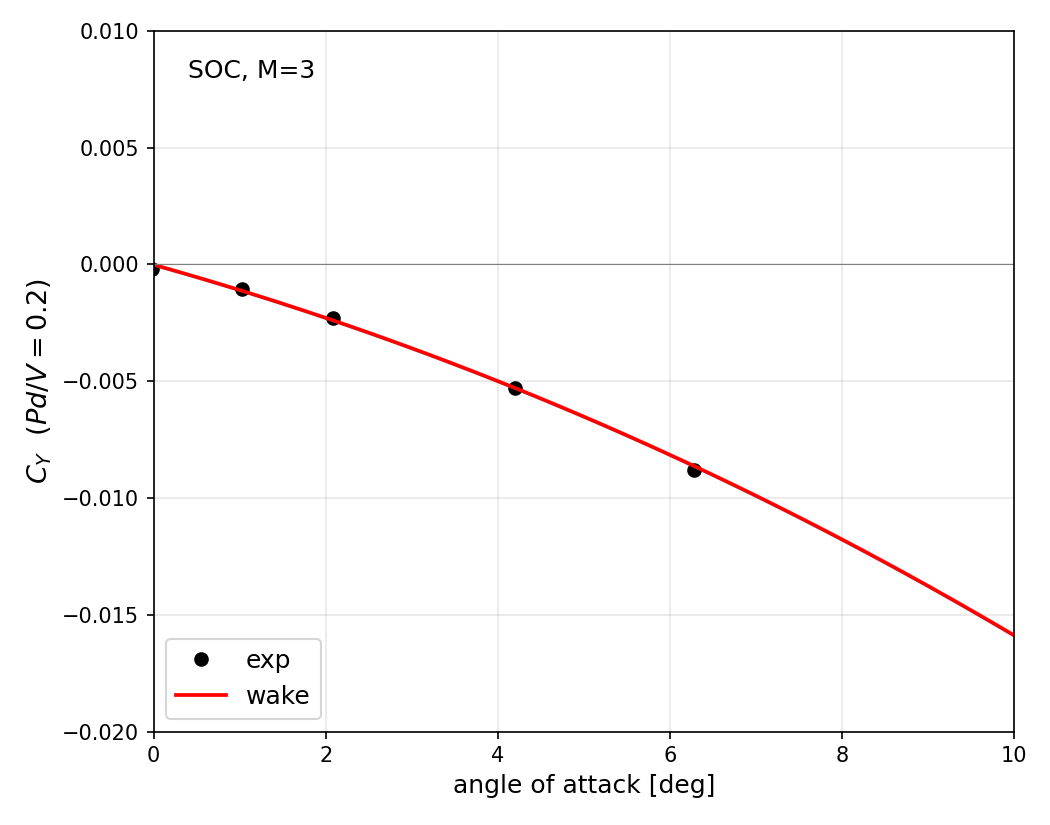
C_Yp versus angle of attack, CFD versus experiment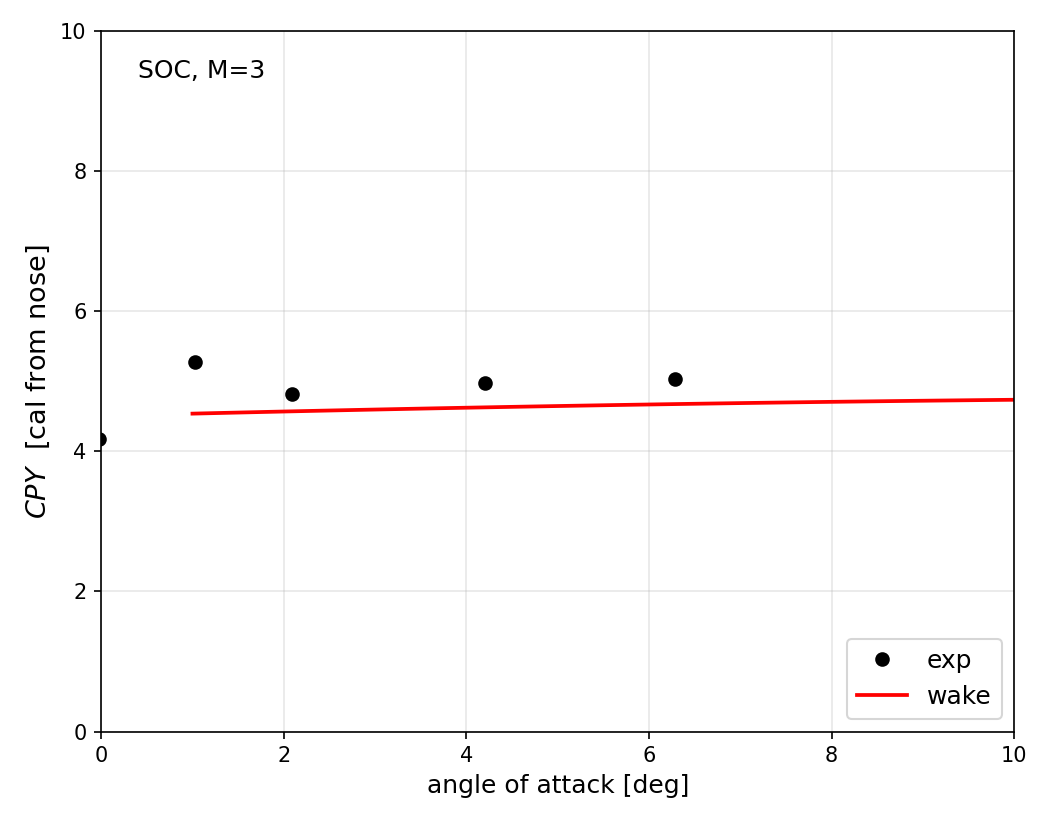
CPY versus angle of attack, CFD versus experimentAt α = 4° and 6°, Magnus side force (C_Yp) agrees with experiment within 2%, but Magnus moment (C_np) is consistently further off (−7.3% at both angles) — the spin-induced side-force magnitude is well captured, but its distribution along the body is not: CPY (center of pressure = C_np/C_Yp, roughly) comes out systematically forward of the experimental value because the moment under-predicts by more than the force does. Averaged over |α|≥2°, CPY = 4.65 calibers (CFD) versus 4.90 calibers (experiment), a 0.25-caliber (−5%) forward offset. At low angle of attack (α=1°–2°), the experimental Magnus moment itself becomes poorly conditioned (the reference notes large measurement uncertainty in this range), which is the most likely explanation for the larger apparent deviation there. At α=10°, both Magnus coefficients deviate by about 20% — the experiment shows Magnus force saturating with angle of attack while the CFD continues to grow faster than linearly; this deviation is within the experimental measurement uncertainty band that the reference itself reports as “large” for Magnus data, but it remains the one clearly open physical question in this comparison.
26.9 Conclusions and Applicable Scope
- Wake CFD’s rotating-wall boundary condition produces Magnus side-force coefficients within 2% of experiment at
α=4°and6°, and the underlying static coefficients (which share the same mesh and numerical setup) agree with experiment within about 3% acrossα=0°–10°. - The one clear open discrepancy is at
α=10°, where both Magnus coefficients deviate by about 20% in a way not explained by the rest of the comparison — within the experiment’s own reported “large” uncertainty for Magnus measurements, but not yet independently resolved on the CFD side. - Grid convergence has not been performed for this case — only boundary-layer (near-wall spacing) resolution was swept to convergence; a systematic volume-mesh refinement study (independent of boundary-layer spacing) has not been done. The reported agreement therefore reflects model accuracy combined with unquantified remaining discretization error, not model accuracy alone.
- The experimental nose tip is mathematically sharp; the CFD model uses a small blunting radius (
0.87%of caliber) to permit meshing. The local pressure field near the tip differs as a result, though the integrated-force contribution of this region is negligible given its small area fraction. - The experimental model’s boundary-layer trip rings (three rings at
0.71calibers from the nose) are not modeled; the CFD instead assumes a fully turbulent boundary layer from the nose. This is the most likely cause of the Magnus center-of-pressure offset: net Magnus force agrees with experiment within 2%, so the spin-induced side-force mechanism itself is captured correctly, but its distribution along the body depends on boundary-layer history, which differs between the tripped experiment and the untripped CFD. A follow-on run with the trip rings modeled is needed to confirm this and close the gap. - This result applies to one geometry (SOC, no boat-tail), one Mach number (3.0), and the angle-of-attack and spin-rate ranges tested. It does not establish accuracy at other Mach numbers, for boat-tailed variants, or with the sting/base-flow hardware modeled explicitly.
26.10 References
- Nietubicz, C. J., and Opalka, K. O., Supersonic Wind Tunnel Measurements of Static and Magnus Aerodynamic Coefficients for Projectile Shapes with Tangent and Secant Ogive Noses, US Army Ballistic Research Laboratory, ARBRL-MR-02991, February 1980 (AD-A083297).