20 2D NACA0012 Airfoil — SA RANS Polar Validation
Lift, drag, and stall behavior against wind-tunnel data (Ladson/Abbott), with code-to-code agreement against NASA TMR CFL3D-SA in the attached-flow range
20.1 Run Provenance and Artifacts
| Item | Value |
|---|---|
| Wake CFD baseline version | 0.22.2 |
| Solver | DBNS |
| Compute device | GPU (NVIDIA RTX A6000) |
| Parallel execution | 1 MPI rank |
| Arithmetic precision | FP64 |
| Run date | 2026-09-09 |
Results depend on the solver build that produced them. Read every figure in this report together with the version and date above — re-running the same input on a later build may give different numbers.
20.1.1 Downloadable Files
Not available: standalone input decks and solver result files have not yet been published for download.
20.2 Validation Objective
The NACA0012 airfoil is one of the most widely used cases for validating RANS turbulence models, in part because the NASA Turbulence Modeling Resource (TMR) publishes both curated wind-tunnel data (Ladson; Abbott & von Doenhoff) and matched-condition Spalart–Allmaras (SA) computations from the established CFL3D code. This case reproduces the NACA0012 lift/drag polar with Wake CFD’s SA implementation on a TMR-family mesh, and checks two different things at once:
- Code-to-code agreement with CFL3D-SA in the linear, attached-flow range, where two independent RANS codes solving the same equations on comparable meshes should agree closely if both are implemented correctly.
- Agreement with experiment (Ladson, Abbott & von Doenhoff) across the full angle-of-attack range, including lift-curve slope, maximum lift, and stall.
For users, this result supports confidence in Wake CFD’s SA implementation for conventional 2D lift/drag prediction in attached flow, and documents the size and direction of the expected error near and beyond stall.
20.3 Reference Solution and Data
| Item | Setting |
|---|---|
| Reference (linear range) | CFL3D-SA, NASA TMR (code-to-code) |
| Reference (full range) | Ladson (NASA TM-4074, 80/120/180-grit trip) and Abbott & von Doenhoff (untripped), wind-tunnel experiment |
20.4 Simulation Conditions
| Item | Setting |
|---|---|
| Geometry | NACA0012 2D airfoil, chord c=1 |
| Analysis | Steady, compressible DBNS, RANS |
| Freestream Mach | 0.15 |
| Reynolds number | Re_c=6.0×10^6 |
| Angle of attack | -10° to 19°, 20 points |
Constant viscosity is used in place of Sutherland’s law so that Re_c matches the target value exactly, following the same practice as other Wake CFD TMR verification cases.
20.5 Mesh
| Item | Setting |
|---|---|
| Mesh | 2D structured mesh, NASA TMR NACA0012 family (single-cell-thick 2D extraction of the 3D family used in TMR’s grid-convergence study); primary grid 897×257, spot-checked against 449×129 at AoA=0°, 10°, 15° |
20.6 Boundary and Initial Conditions
N/A: Detailed boundary and initial conditions are not documented for this case.
20.7 Numerical Methods
| Item | Setting |
|---|---|
| Turbulence model | Spalart–Allmaras, standard/ft2=true (“classic” SA, matching the CFL3D convention used by TMR) |
| Convective scheme | Roe (default entropy fix) |
| Spatial accuracy | Second order, no limiter |
| Gradient reconstruction | Green–Gauss |
| Nonlinear control / preconditioner | HANIM (adaptive nonlinear control) with a Jacobi linear-solver preconditioner |
| Convergence criterion | Cauchy-window monitor on CD (eps=1e-6 over a 1000-iteration window), max_iter=40000 |
20.8 Results
20.8.1 Linear Range (-10° to 10°)
Wake CFD’s lift-curve slope lies on top of both the CFL3D-SA point and the Ladson/Abbott experimental scatter over the full linear range.
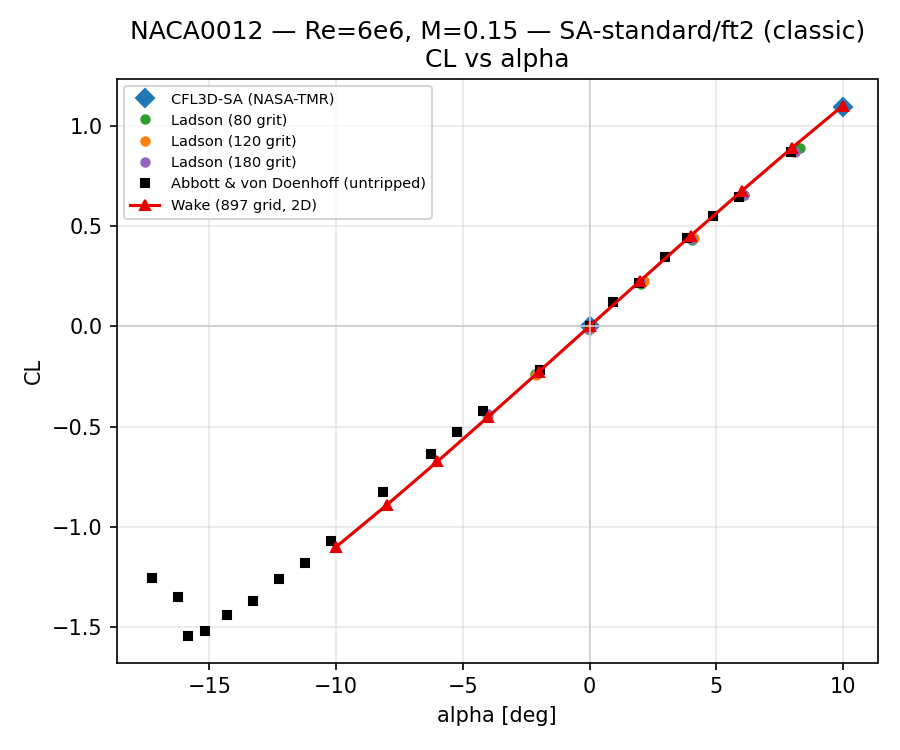
Re_c=6×10^6, M=0.15: CL vs alpha, linear rangeDrag is compared on an expanded axis (5-count ticks) to make small differences visible:
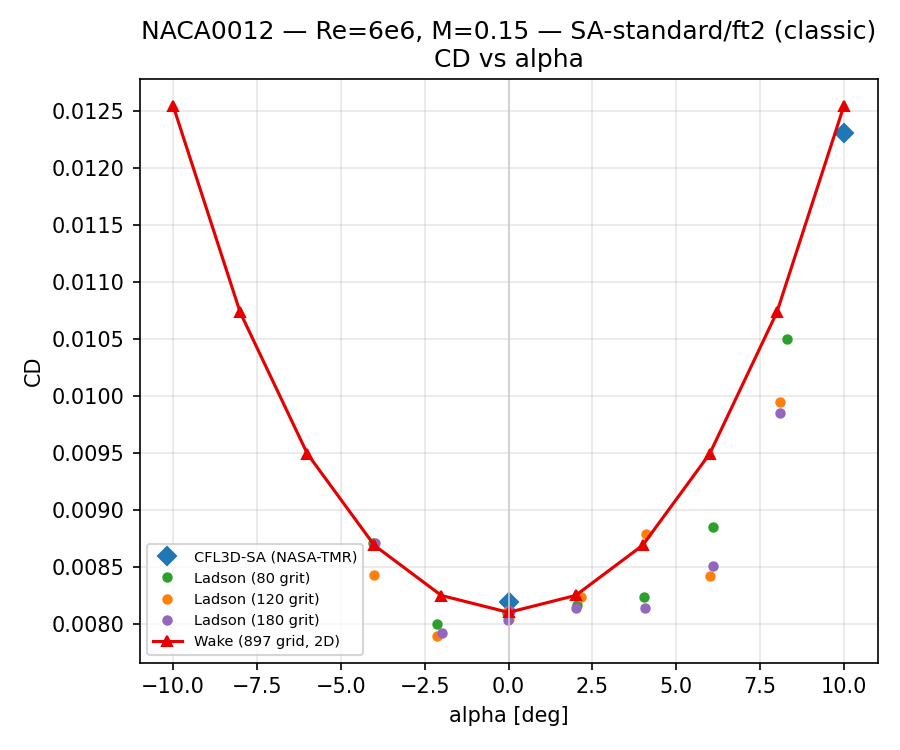
Re_c=6×10^6, M=0.15: CD vs alpha, linear range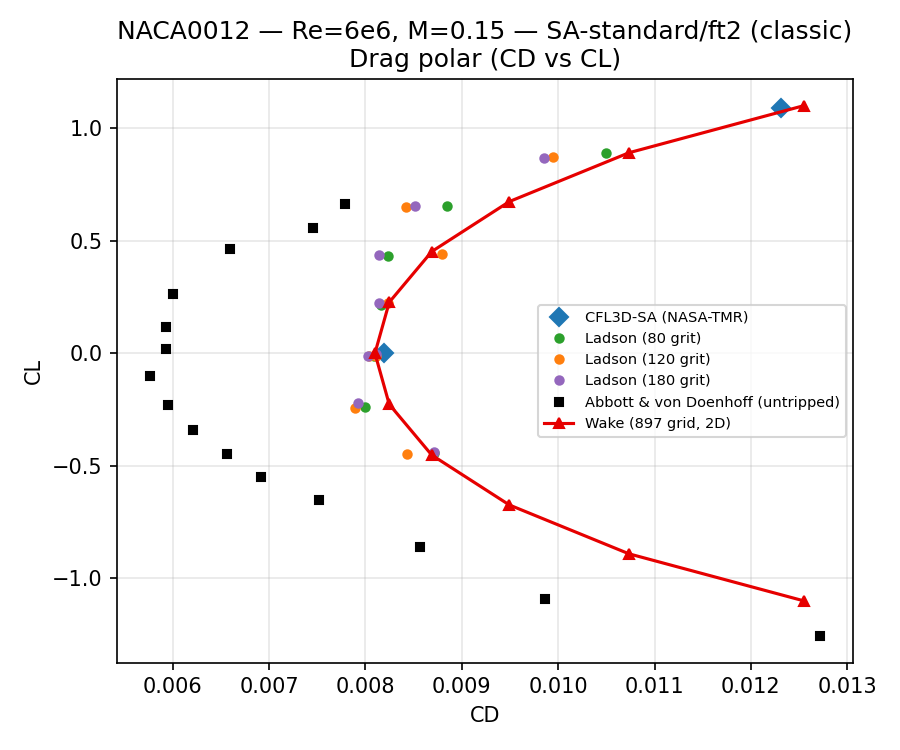
Re_c=6×10^6, M=0.15: drag polar, linear rangeA direct CFL3D-SA comparison for these angles is given together with 15° in the next section (Near and Beyond Stall), since the trend across all three points is easier to read as one table.
Left–right symmetry was also checked directly: CD at ±2°, ±4°, ±6°, ±8°, ±10° on the 897×257 mesh agrees to within 0.01 count between positive and negative angle of attack, confirming correct handling of the rotation and force-projection convention.
20.8.2 Near and Beyond Stall (11° to 19°)
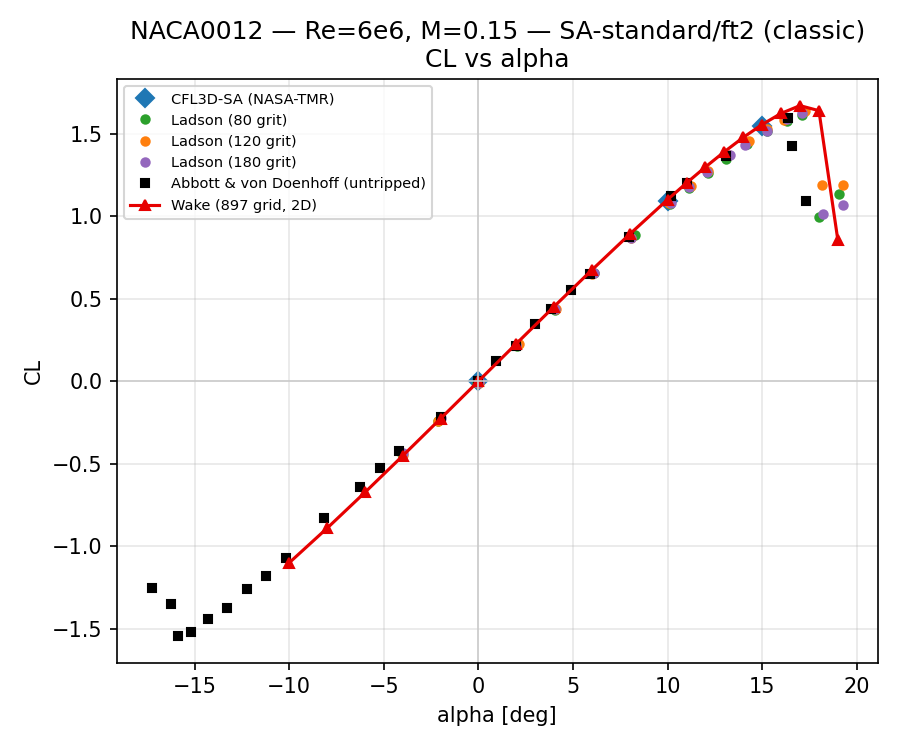
Re_c=6×10^6, M=0.15: CL vs alpha, full range including stall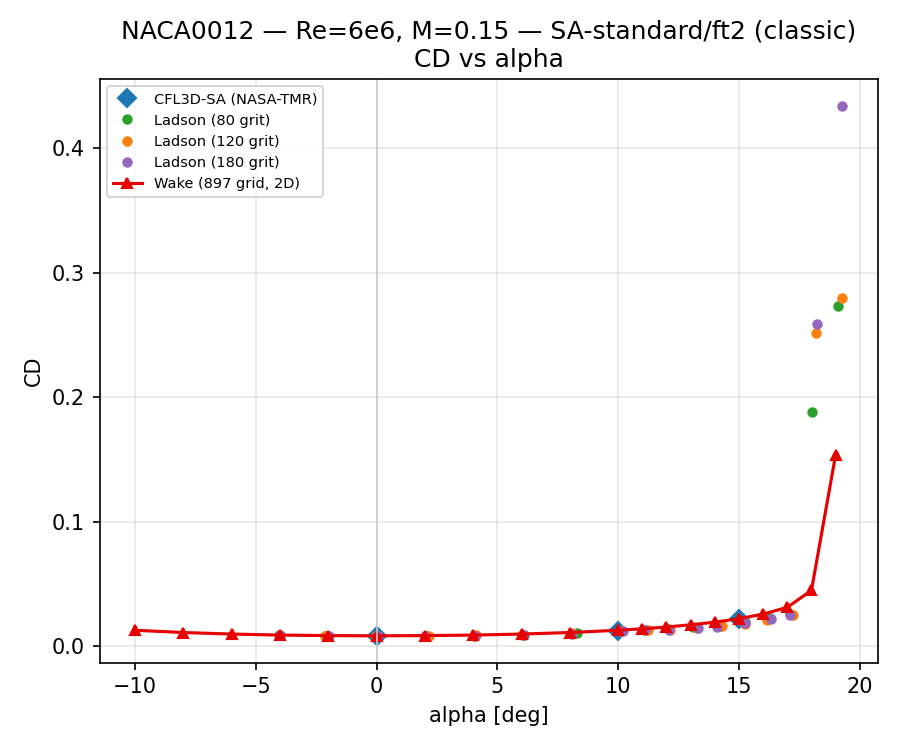
Re_c=6×10^6, M=0.15: CD vs alpha, full range including stall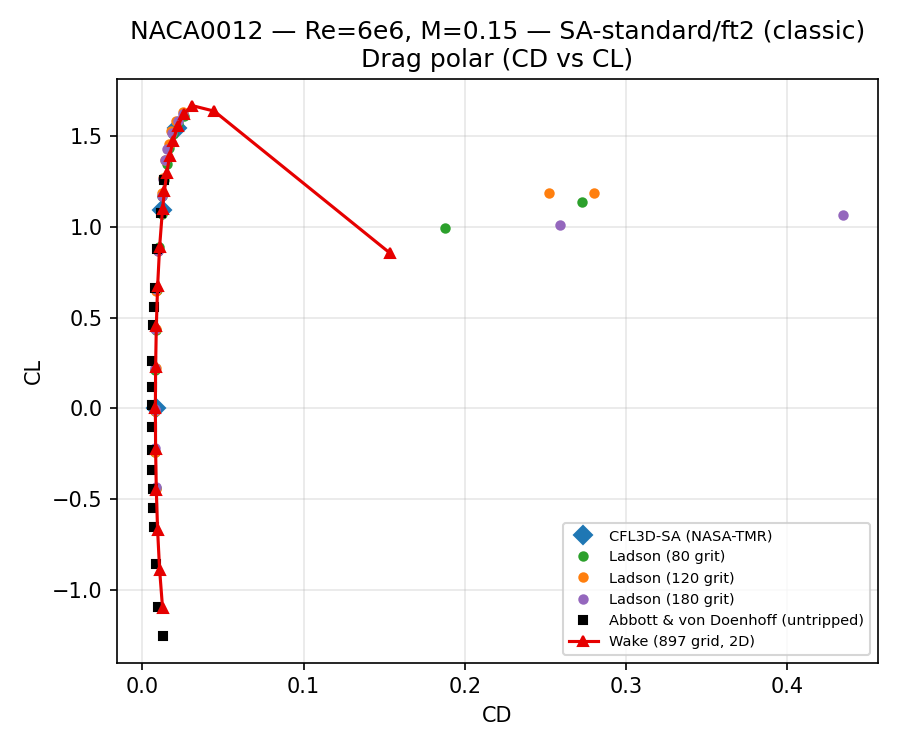
Re_c=6×10^6, M=0.15: drag polar, full range including stallWake CFD reaches CL_max=1.669 at AoA=17°. The experimental references (Ladson 80-grit, Abbott & von Doenhoff untripped) peak about 1°–2° earlier, near 15°–16°, at CL_max≈1.5–1.6. Drag shows the same pattern: Wake CFD’s drag rise beyond stall is real but softer and later than the experimental rise. This is the well-documented tendency of steady RANS with a one-equation turbulence model (SA) to delay separation and over-predict CL_max — it is not specific to this solver.
The CFL3D-SA code-to-code comparison covers AoA=0°, 10° (linear range) and extends one point further, to AoA=15° — still attached, just before the stall break at 17°:
AoA |
CFL3D-SA CD (counts) |
Wake CFD 897×257 difference (counts) |
Wake CFD 449×129 difference (counts) |
|---|---|---|---|
0° |
81.92 | -0.94 |
-1.40 |
10° |
123.11 | +2.40 |
+11.98 |
15° |
212.37 | +6.13 |
+32.47 |
(1 count = 0.0001 in CD.) On the primary 897×257 mesh, Wake CFD matches CFL3D-SA to within about 2.5 counts in the linear range, and the gap keeps growing smoothly with angle of attack out to 15° (-0.94 → +2.40 → +6.13 counts) rather than jumping suddenly — consistent with gradually approaching, but not yet inside, separated flow. The coarser 449×129 mesh shows a larger and faster-growing gap (-1.40 → +11.98 → +32.47 counts), consistent with that mesh being under-resolved relative to the primary grid rather than with a modeling error — grid convergence itself has not been established for this configuration (see Applicable Scope).
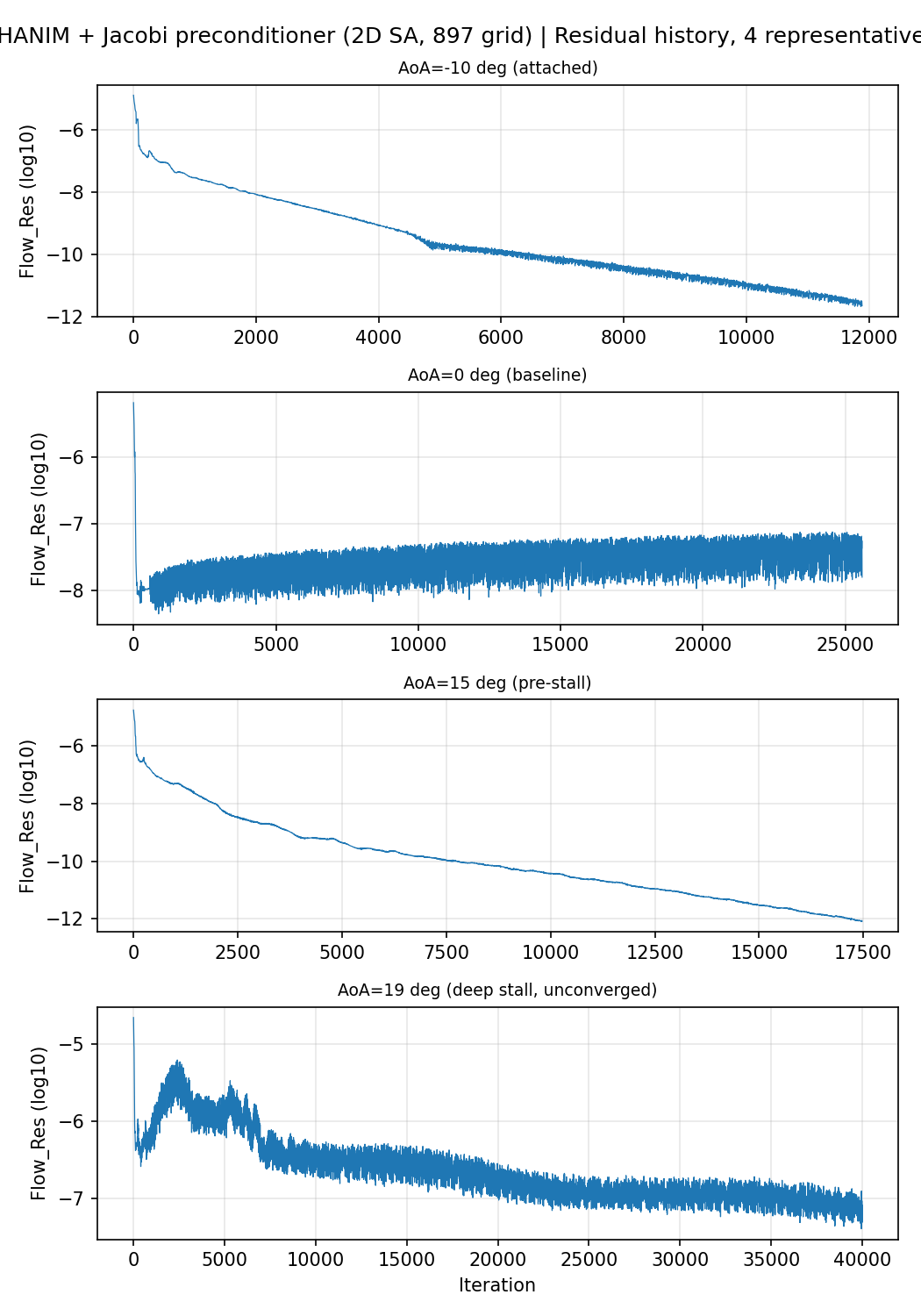
Two angle-of-attack/mesh combinations did not reach the specified convergence tolerance within 40000 iterations:
449×129atAoA=0°— isolated to this single coarse-mesh/angle combination; the finer897×257mesh at the same angle converges normally, and the root cause has not yet been identified.897×257atAoA=18°, 19°— the two most deeply stalled points. Over the final1000iterations,CDoscillates within a bounded range (about3and30counts respectively) rather than diverging, consistent with genuinely unsteady separated flow that a steady solver cannot bring to a single fixed point.
20.8.3 Convergence History
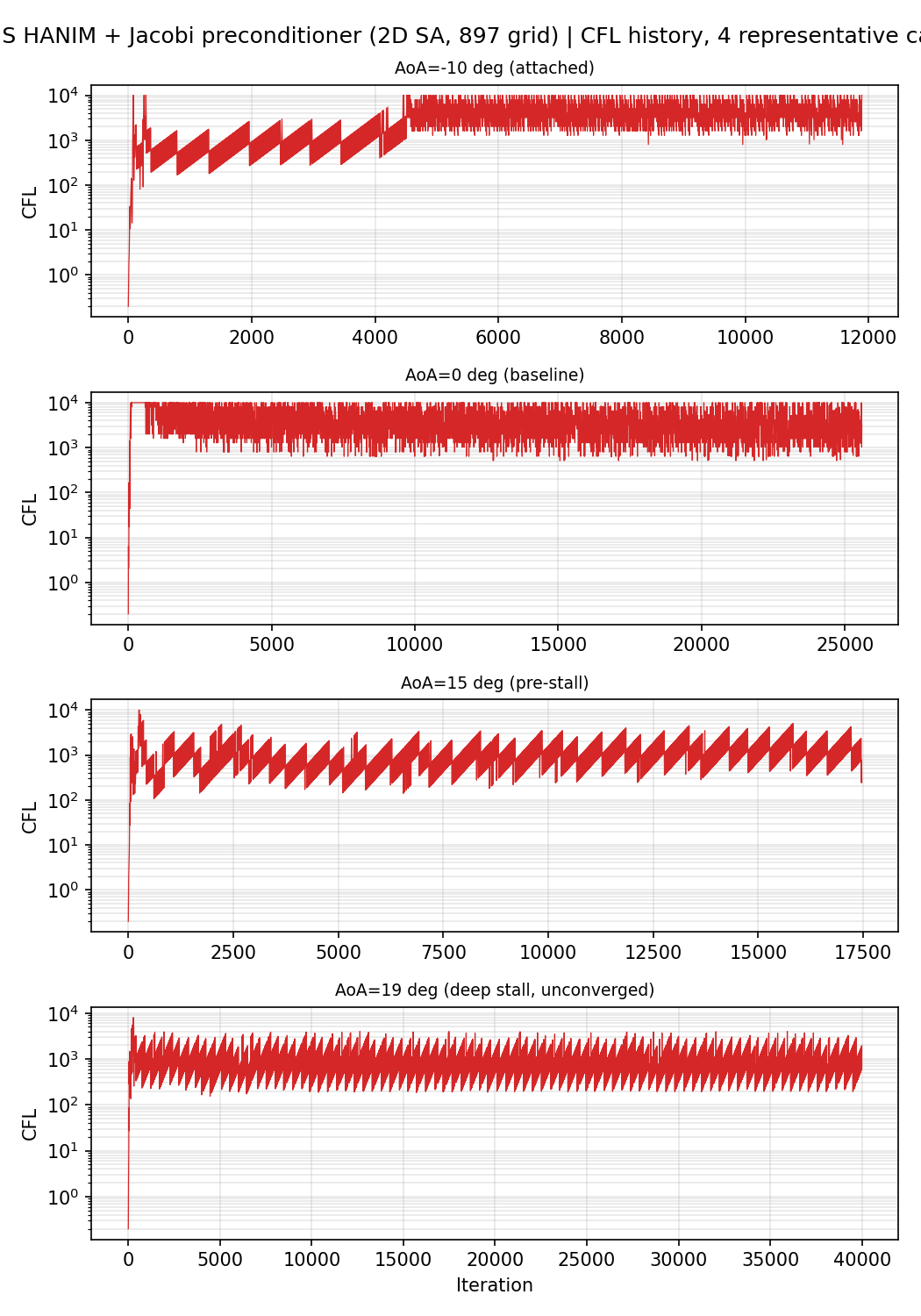
CFL is controlled by HANIM (adaptive nonlinear control), so its history is reported alongside the residual for four representative cases spanning the sweep: an attached case (AoA=-10°), the baseline (AoA=0°), a pre-stall case (AoA=15°), and the deepest unconverged stall case (AoA=19°).
20.9 Conclusions and Applicable Scope
- Wake CFD with SA, the Roe scheme, no limiter, Green–Gauss gradients, and HANIM nonlinear control with a Jacobi preconditioner reproduces CFL3D-SA to within about
2.5drag counts in attached flow (-10°to10°) on the primary897×257mesh, and matches the Ladson/Abbott lift-curve slope closely. - Near and beyond stall, expect Wake CFD/SA to predict a
CL_maxroughly5–10%higher than experiment,1°–2°later in angle of attack, with a correspondingly delayed and softened drag rise — consistent with the known behavior of steady RANS with one-equation turbulence models, not a Wake CFD-specific defect. - This case establishes 2D, steady RANS/SA performance at one Mach number and one Reynolds number on one mesh family. It does not by itself establish grid-converged accuracy — only two mesh densities were compared, and only at three angles of attack — and it does not cover 3D/finite-span effects, transition, or other turbulence models (SST is not covered by this case).
- The two non-converged points (
449×129/0°and897×257/18°–19°) should be treated as open items rather than resolved behavior; see the run notes for follow-up.
20.10 References
- Rumsey, C.L., “2D NACA 0012 Airfoil Validation Case (Numerics),” NASA Turbulence Modeling Resource.
- Ladson, C.L., “Effects of Independent Variation of Mach and Reynolds Numbers on the Low-Speed Aerodynamic Characteristics of the NACA 0012 Airfoil Section,” NASA TM-4074, 1988.
- Abbott, I.H., and von Doenhoff, A.E., Theory of Wing Sections, Dover Publications, 1959.