15 Laminar Cylinder Vortex Shedding — Strouhal/CD/CL Validation
Validation of unsteady flow, curved meshes, and force integration in the Flux Reconstruction solver (against literature and DBNS)
15.1 Run Provenance and Artifacts
| Item | Value |
|---|---|
| Wake CFD baseline version | 0.22.2 |
| Solver | FR |
| Compute device | GPU (NVIDIA A2000) |
| Parallel execution | 1 MPI rank |
| Arithmetic precision | FP64 |
| Run date | 2026-07-19 |
Results depend on the solver build that produced them. Read every figure in this report together with the version and date above — re-running the same input on a later build may give different numbers.
15.1.1 Downloadable Files
Not available: standalone input decks and solver result files have not yet been published for download.
15.2 Validation Objective
This case simulates laminar vortex shedding around a circular cylinder with the FR (Flux Reconstruction) solver and compares the results with published values and those from Wake CFD’s FVM-based DBNS solver. Unlike the steady-flow Cases 01 and 02, this is an unsteady flow case that verifies the FR solver implementation in terms of:
- vortex-shedding frequency (Strouhal number)
- mean drag coefficient and lift-coefficient amplitude
- viscous-force integration on curved high-order elements (a Q2 O-grid)
- cross-solver validation between the independently implemented FVM (DBNS) and FR solvers
15.3 Reference Solution and Data
Flow around a circular cylinder at Re_D=100 is a representative unsteady validation case that produces a regular Kármán vortex street and has well-established literature values for Strouhal number, drag, and lift amplitude. A low-Mach (M=0.05) compressible formulation is used to model an essentially incompressible flow.
The same physical condition is also simulated with Wake CFD’s production FVM solver (DBNS), providing cross-validation through two independent numerical paths.
| Item | Setting |
|---|---|
| References | Williamson 1988 (St), Henderson 1995 (C_D), and the Wake CFD DBNS solver for cross-validation |
15.4 Simulation Conditions
| Item | Setting |
|---|---|
| Geometry | Circular cylinder, D=1 m, outer boundary R_out=20D |
| Analysis | Unsteady, compressible laminar Navier–Stokes |
Re_D |
100 |
| Mach | 0.05 (mu=0.2081 is used to match Re_D) |
| Reference state | ISA sea level — P=101325 Pa, T=288.15 K → rho=1.2218, U=17.03 m/s |
| Total simulation time | t=24 s (24,000 steps) |
| FFT window | t=12→24 s (about 34 cycles; initial transient excluded) |
15.5 Mesh
| Item | Setting |
|---|---|
| Mesh | Curved Q2 O-grid, 96(θ) × 64(r), first wall-cell height Δr≈0.030 |
15.6 Boundary and Initial Conditions
| Item | Setting |
|---|---|
| Wall | no-slip, adiabatic |
| Outer boundary | farfield |
Initial field: Not reported.
15.7 Numerical Methods
| Item | Setting |
|---|---|
| Physical time step | dt=1×10^-3 s |
| Spatial accuracy | FR p2 (third order) |
| Time integration | Dual time — physical: BDF1; pseudo-time: RK45 + local-PI CFL control + p-multigrid |
15.8 Results
Time averaging and FFT analysis over t=12→24 s (about 34 cycles) are compared with literature values and DBNS results at the same condition.
| Metric | FR p2 (BDF1, dt=1e-3) |
DBNS BDF1 (same scheme and dt) |
DBNS BDF2 | Literature |
|---|---|---|---|---|
St |
0.1615 | 0.1651 | 0.1670 | 0.164 (Williamson 1988) |
Mean C_D |
1.3203 ± 0.0041 | 1.3430 ± 0.0058 | 1.3592 | 1.35 (Henderson 1995) |
C_L amplitude |
0.2678 | 0.3088 | 0.3347 | ≈0.33 |
St (drag component, ≈2·St) |
0.3229 | 0.3303 | 0.3340 | 0.328 |
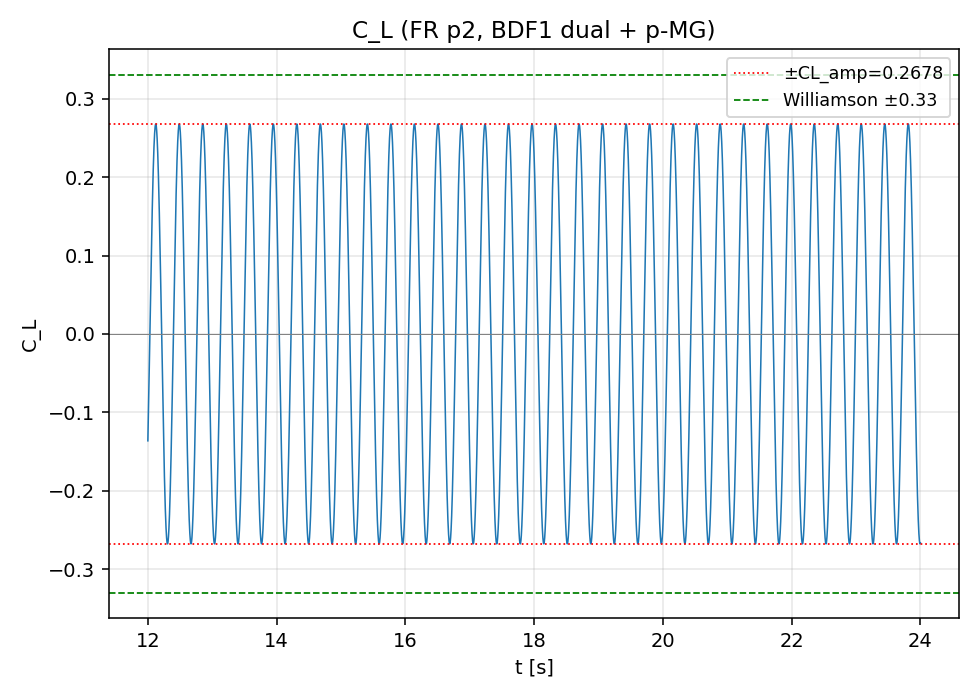
C_L(t) time history — reaches a regular vortex-shedding amplitude after the initial transient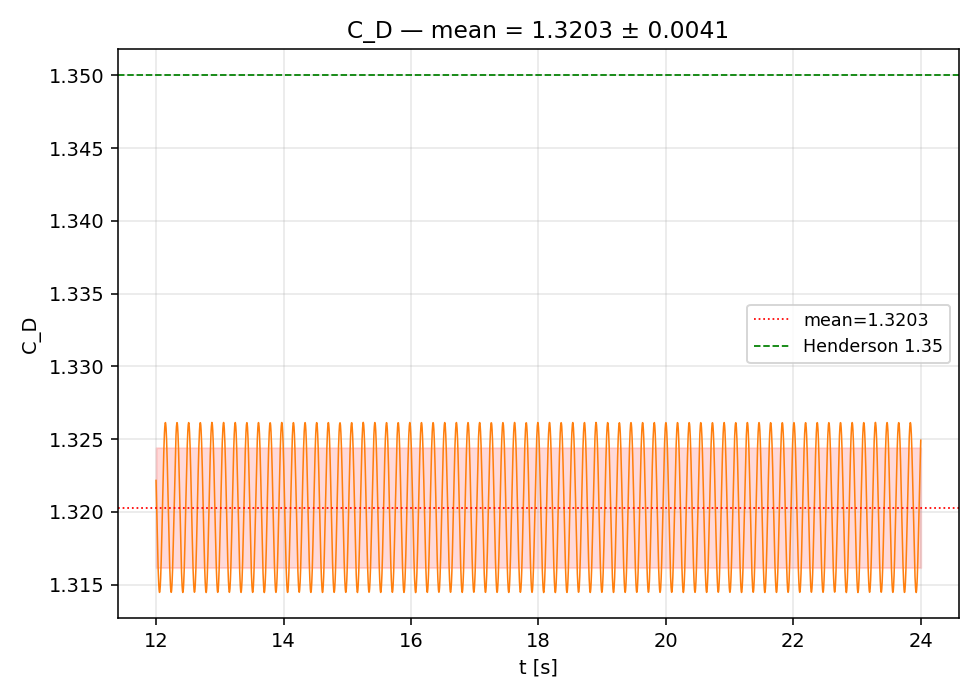
C_D(t) time history — comparison of the time mean with the Henderson reference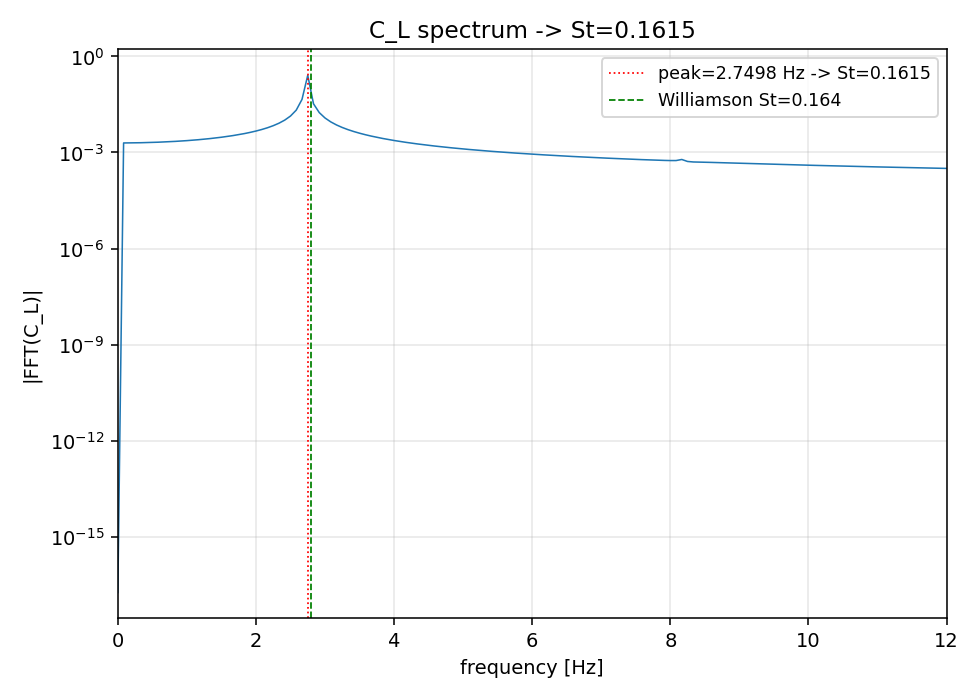
C_L spectrum — Strouhal number extracted from the dominant frequency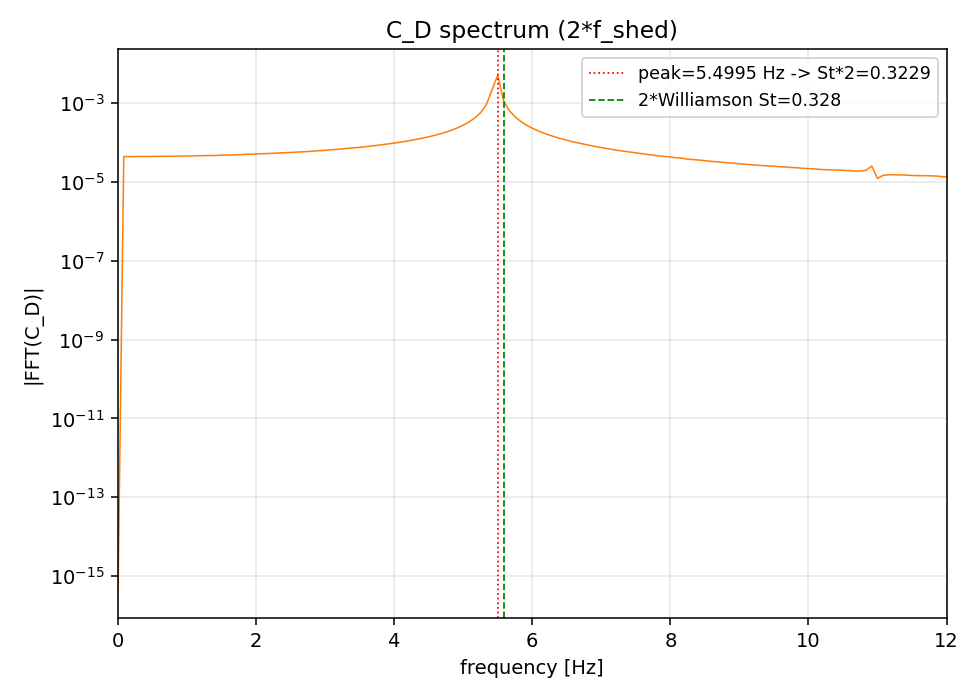
C_D spectrum — peak at twice the vortex-shedding frequencySt agrees with the literature value within 2%. The drag-spectrum peak occurs at exactly twice the lift-spectrum frequency, reproducing the expected physics: vortices shed alternately from the two sides of the cylinder, so drag oscillates at twice the lift frequency. The C_L amplitude is somewhat lower than the literature and DBNS values. This is consistent with numerical damping from first-order BDF1 time integration; DBNS likewise gives a lower value with BDF1 than with BDF2.
FR and DBNS are two independent numerical paths that do not share a code base. With the same time-integration scheme (BDF1) and dt, they agree broadly, with differences of −2.2% in St, −1.7% in C_D, and −13.3% in C_L amplitude.
15.9 Conclusions and Applicable Scope
- For vortex shedding from a cylinder at
Re_D=100, the FR solver agrees with literature within 5% forStandC_D, and within 25% forC_Lamplitude, which is the case acceptance criterion. - Wake CFD’s two solvers (FR and DBNS), which do not share a code base, agree in
StandC_Dat the same condition, confirming that both implementations reproduce the same physics independently. The comparatively larger discrepancy inC_Lamplitude among the solvers and literature requires further study. - These results were obtained for one Reynolds number (
Re_D=100), one mesh, and one time-integration scheme (BDF1). They cannot be generalized to mesh or time-step convergence, higher Reynolds numbers, or three-dimensional effects. - Follow-on validation should compare polynomial-order (
p) convergence,dtconvergence, and higher-order time integration (sdirk33) as independent variables. - The effects of time-integration order (
BDF1versusBDF2) and arithmetic precision (FP32versusFP64) on this flow are covered separately for the DBNS solver in the time-integration and precision comparison case.
This case shows, through literature comparison and cross-solver validation, that the FR solver’s integrated unsteady viscous-flow, curved high-order-element, and force-integration path functions correctly. It establishes a minimum validation baseline for this range of conditions rather than an absolute accuracy guarantee.
15.10 References
- Williamson, C. H. K., “Defining a Universal and Continuous Strouhal–Reynolds Number Relationship for the Laminar Vortex Shedding of a Circular Cylinder,” Physics of Fluids, 31(10), 1988, pp. 2742–2744.
- Henderson, R. D., “Details of the Drag Curve near the Onset of Vortex Shedding,” Physics of Fluids, 7(9), 1995, pp. 2102–2104.