11 Prandtl-Meyer Expansion Fan — Isentropic Verification
Post-expansion Mach number, pressure, and temperature ratios against the exact Prandtl-Meyer / isentropic relations
11.1 Run Provenance and Artifacts
| Item | Value |
|---|---|
| Wake CFD baseline version | 0.22.1 |
| Solver | DBNS |
| Compute device | CPU |
| Parallel execution | 1 MPI rank |
| Arithmetic precision | FP64 |
| Run date | 2026-09-21 |
Results depend on the solver build that produced them. Read every figure in this report together with the version and date above — re-running the same input on a later build may give different numbers.
11.1.1 Downloadable Files
Not available: standalone input decks and solver result files have not yet been published for download.
11.2 Verification Objective
This case simulates a supersonic flow expanding around a 15° convex corner, reproducing the NASA GRC WIND validation archive’s Prandtl-Meyer expansion case. The Prandtl-Meyer function combined with the isentropic relations gives an exact closed-form solution for the post-expansion Mach number, pressure ratio, and temperature ratio, against which the Wake CFD Euler solution is compared directly. It verifies Wake CFD’s inviscid solver for:
- resolution of a centered expansion (simple) wave originating at a sharp corner
- isentropic accuracy (pressure, Mach number, and temperature all following the exact relations consistently)
11.3 Reference Solution and Data
| Item | Setting |
|---|---|
| Reference | Exact Prandtl-Meyer function + isentropic relations |
11.4 Simulation Conditions
| Item | Setting |
|---|---|
| Geometry | Flat wall to x = 0.3 m, then a 15° convex corner; domain to x = 2.0 m, y = 1.0 m |
| Analysis | Steady, inviscid (Euler), ideal-gas air (γ=1.4) |
| Freestream | M = 2.5, p = 82,737.09 Pa, T = 305.56 K |
Exact solution at θ=15°, M₁=2.5: solving ν(M₂) = ν(M₁) + θ for the Prandtl-Meyer function ν(M) gives M₂ = 3.2368, with isentropic ratios p₂/p₁ = 0.3274, T₂/T₁ = 0.7269, ρ₂/ρ₁ = 0.4505. (These values agree with the temperature and density ratios independently published in the NASA WIND-US reference solution — T₂/T₁ = 0.7282, ρ₂/ρ₁ = 0.4497 — to within the reference CFD solution’s own discretization error.)
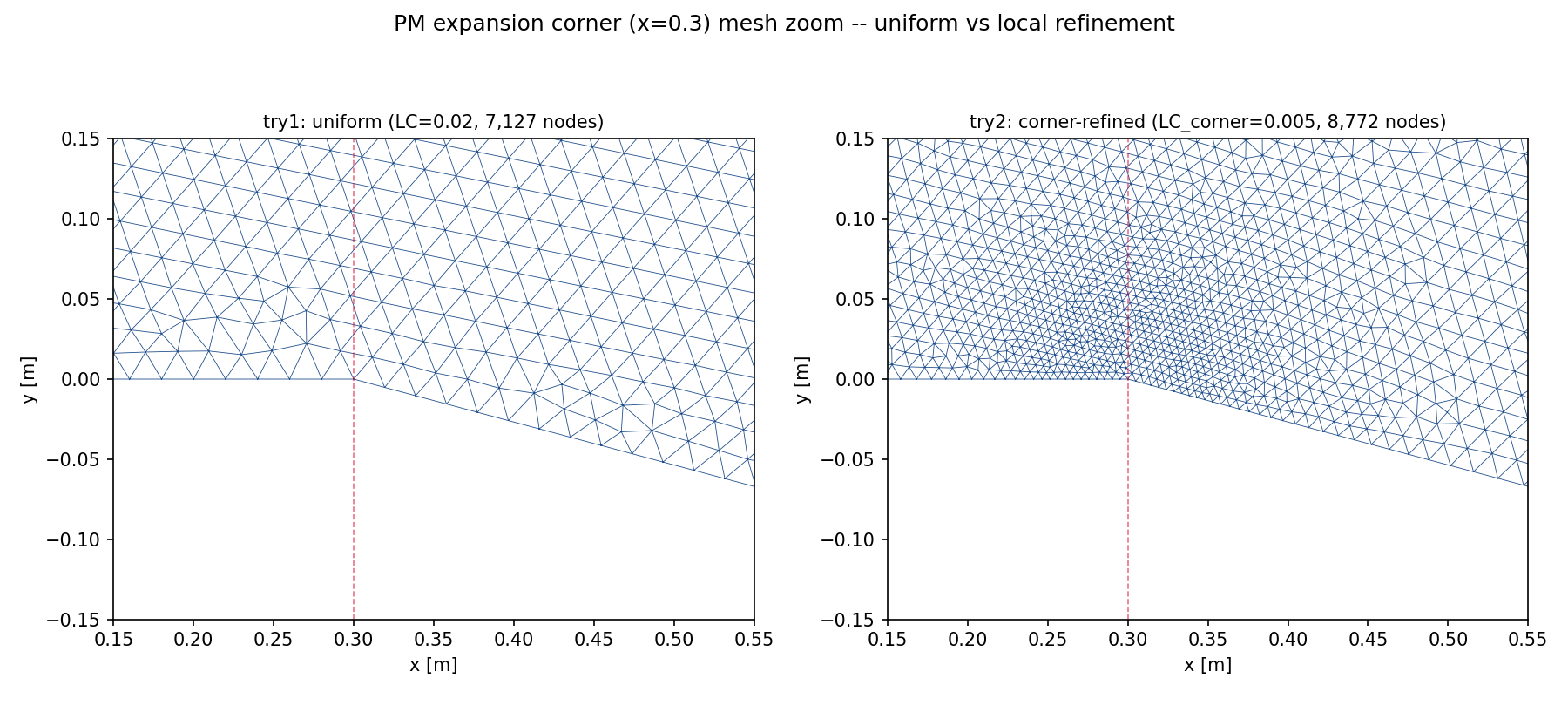
A uniform background mesh under-resolves the corner, which is a point singularity in the exact solution (a centered fan originating from a single point). This locally generates numerical entropy that does not fully relax downstream, causing the Mach number and temperature (which depend on the full entropy state) to diverge further from the exact isentropic solution than the pressure ratio (which is set mostly by local wave structure). Corner-local mesh refinement resolves this; limiter freezing after the initial transient was needed for the refined-mesh case to reach a stable converged state efficiently (rather than a bounded, non-decaying residual oscillation) without changing the converged solution itself.
11.5 Mesh
| Item | Setting |
|---|---|
| Mesh | Unstructured triangular (gmsh), locally refined near the corner (cell size reduced 4× within a 0.05 m radius of the corner, blending back to the background size) — 8,772 nodes |
11.6 Boundary and Initial Conditions
| Item | Setting |
|---|---|
| Wall | Free-slip (inviscid) |
| Outlet / top | Supersonic pressure outlet |
Initial field: Not reported.
11.7 Numerical Methods
| Item | Setting |
|---|---|
| Convective scheme | Roe with Venkatakrishnan limiter, frozen after the initial transient (limiter.freeze_iter) |
| Gradient method | Green–Gauss |
| Time integration | Implicit, adaptive CFL (1 → 100) |
| Convergence criterion | Absolute residual ≤ -12 OR reduction ≥ 8 orders |
11.8 Results
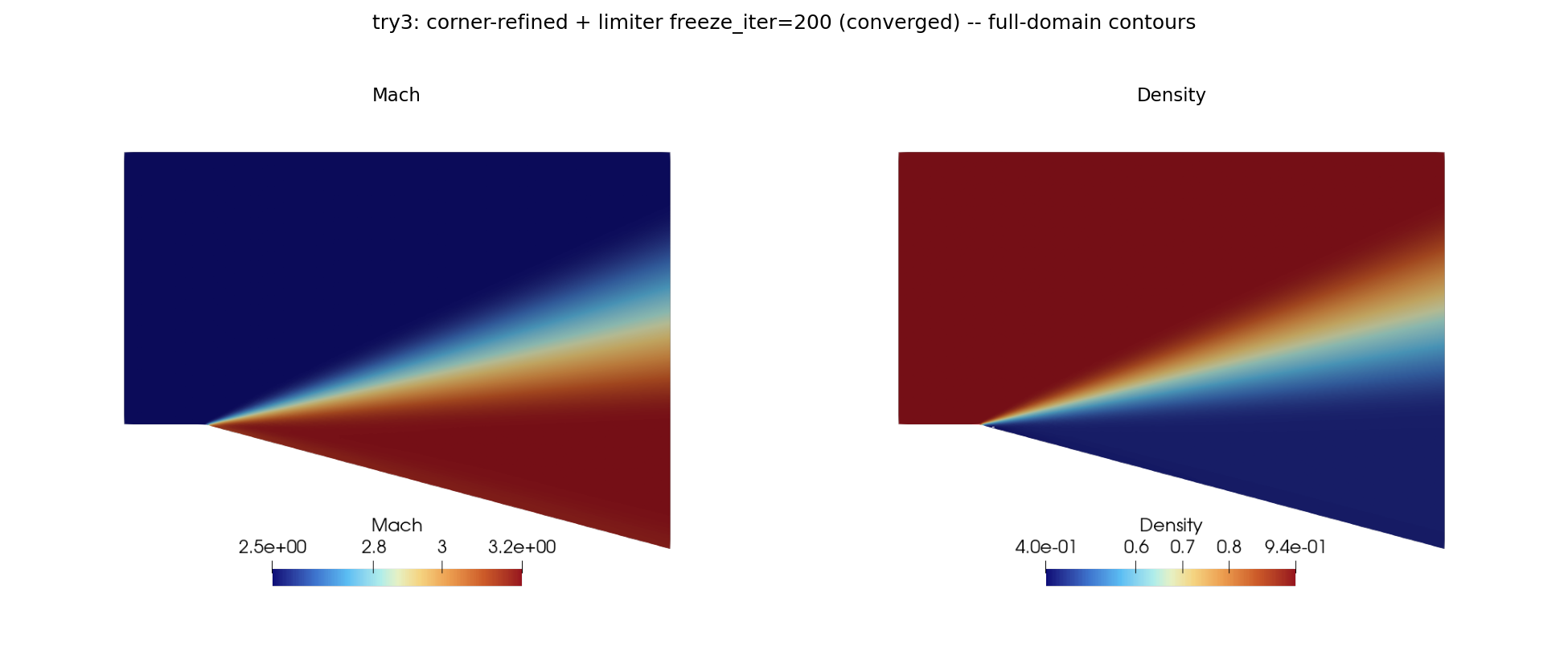
The freestream (M=2.5, dark blue) transitions smoothly through the fan region into the uniform downstream state (M≈3.2, dark red), with the fan’s leading and trailing characteristics visible as clean, nearly straight boundaries.
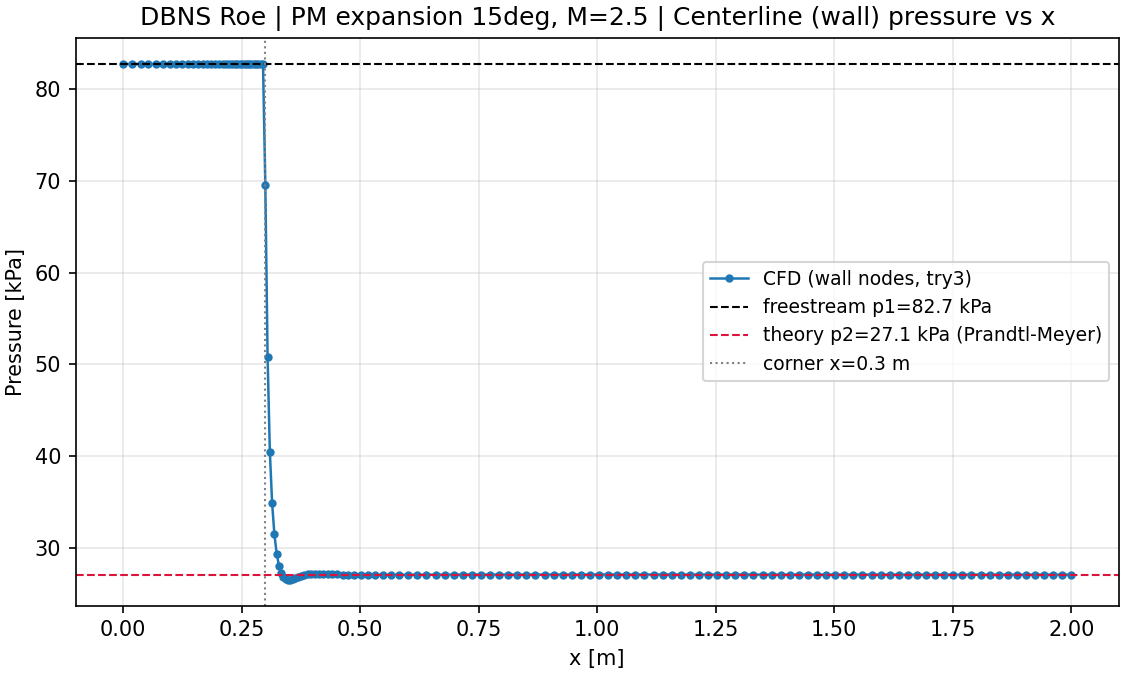
Pressure is uniform at the freestream value upstream of the corner (x=0.3 m), then drops sharply through the fan over a few mesh cells’ width, settling close to the theoretical post-expansion value downstream, with a small local ripple typical of a finite mesh resolving a rapid (near-discontinuous) expansion.
Quantitative comparison at the converged, corner-refined solution:
| Quantity | Exact theory | Wake CFD | Error |
|---|---|---|---|
M₂ |
3.2368 | 3.2147 | −0.68% |
p₂/p₁ |
0.3274 | 0.3274 | +0.005% |
T₂/T₁ |
0.7269 | 0.7336 | +0.91% |
11.9 Conclusions and Applicable Scope
- Wake CFD’s inviscid solver reproduces the exact Prandtl-Meyer expansion to within 1% on all three compared quantities (Mach number, pressure ratio, temperature ratio) when the corner singularity is locally mesh-resolved.
- Pressure ratio is markedly less sensitive to corner mesh resolution than Mach number and temperature, because those depend on the full entropy state rather than local wave structure alone — a useful general lesson for interpreting partial agreement in expansion/compression-corner flows.
- This result applies to a single 2D inviscid expansion-corner configuration at one Mach number and turn angle. It does not establish accuracy for viscous corner flows, compression corners, or three-dimensional geometries.
11.10 References
- NASA Glenn Research Center WIND validation archive, Prandtl-Meyer 15° Expansion, M∞=2.5.