25 3D Sphere Bow Shock — Stand-off Distance Validation
Shock stand-off distance and stagnation pressure against the Billig (1967) correlation and the Rayleigh-Pitot relation, on a mesh-refinement sequence
25.1 Run Provenance and Artifacts
| Item | Value |
|---|---|
| Wake CFD baseline version | 0.22.0 |
| Solver | DBNS |
| Compute device | GPU (NVIDIA RTX A6000) |
| Parallel execution | 1 MPI rank |
| Arithmetic precision | FP64 |
| Run date | 2026-09-22 |
Results depend on the solver build that produced them. Read every figure in this report together with the version and date above — re-running the same input on a later build may give different numbers.
25.1.1 Downloadable Files
Not available: standalone input decks and solver result files have not yet been published for download.
25.2 Validation Objective
This case checks whether Wake CFD’s 3D Euler solver captures the detached bow shock ahead of a sphere in supersonic flow at the correct stand-off distance and stagnation pressure. The reference is the Billig (1967) shock stand-off correlation together with the normal-shock (Rayleigh-Pitot) relation applied along the stagnation streamline — both are correlations fitted to experimental and computational data, so this is a validation case per this report’s classification convention (see Case Directory). Unlike an axisymmetric-stub approach, the mesh here is a genuine unstructured 3D tetrahedral mesh with no axisymmetric simplification.
25.3 Reference Solution and Data
| Item | Setting |
|---|---|
| Reference | Billig (1967) shock stand-off correlation; Rayleigh-Pitot normal-shock relation |
25.4 Simulation Conditions
| Item | Setting |
|---|---|
| Geometry | Sphere, radius R = 0.1 m; farfield boundary at 0.6 m (= 6R); half-domain (z≥0 symmetry plane) |
| Analysis | Steady, inviscid (Euler), ideal-gas air (γ=1.4) |
| Freestream | M = 3.0, p = 101,325 Pa, T = 288.15 K, zero angle of attack |
Billig correlation (sphere, ideal gas): Δ/R = 0.143·exp(3.24/M∞²), giving Δ/R = 0.20497 and Δ = 20.497 mm at M∞=3.
Stagnation-streamline normal-shock relation gives the post-shock stagnation pressure p₀,₂ directly comparable to the CFD wall stagnation-point pressure: p₀,₂ = 1,222,077 Pa at M∞=3.
25.5 Mesh
| Item | Setting |
|---|---|
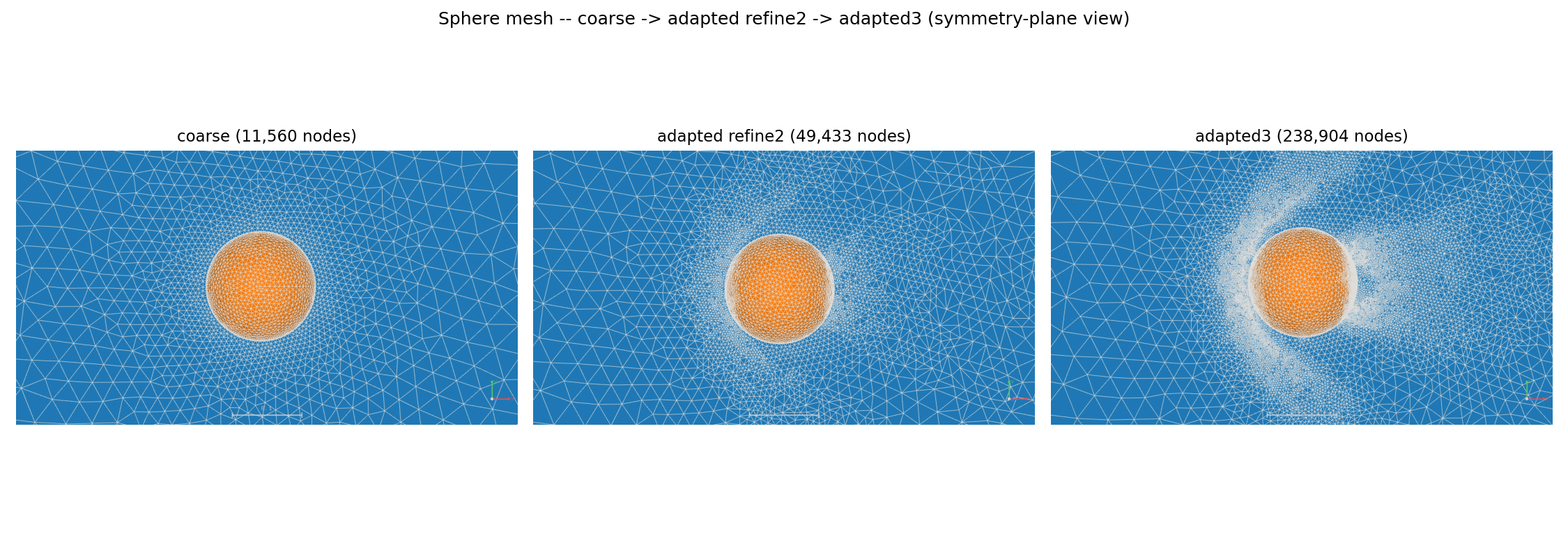
| Mesh sequence | Unstructured tetrahedral; coarse (uniform, 11,560 nodes) refined toward a solution-adaptive, shock-band-targeted sequence: adapt3 (238,904 nodes) and adapt4 (656,764 nodes) |
25.6 Boundary and Initial Conditions
| Item | Setting |
|---|---|
| Wall | Free-slip (inviscid) |
| Farfield | Single characteristic-based boundary covering both the upstream and downstream (wake) regions |
Initial field: Not reported.
25.7 Numerical Methods
| Item | Setting |
|---|---|
| Convective scheme | HLLC |
| Gradient method | Green–Gauss with Venkatakrishnan limiter |
| Time integration | Implicit, CFL constant 5.0 |
25.8 Results
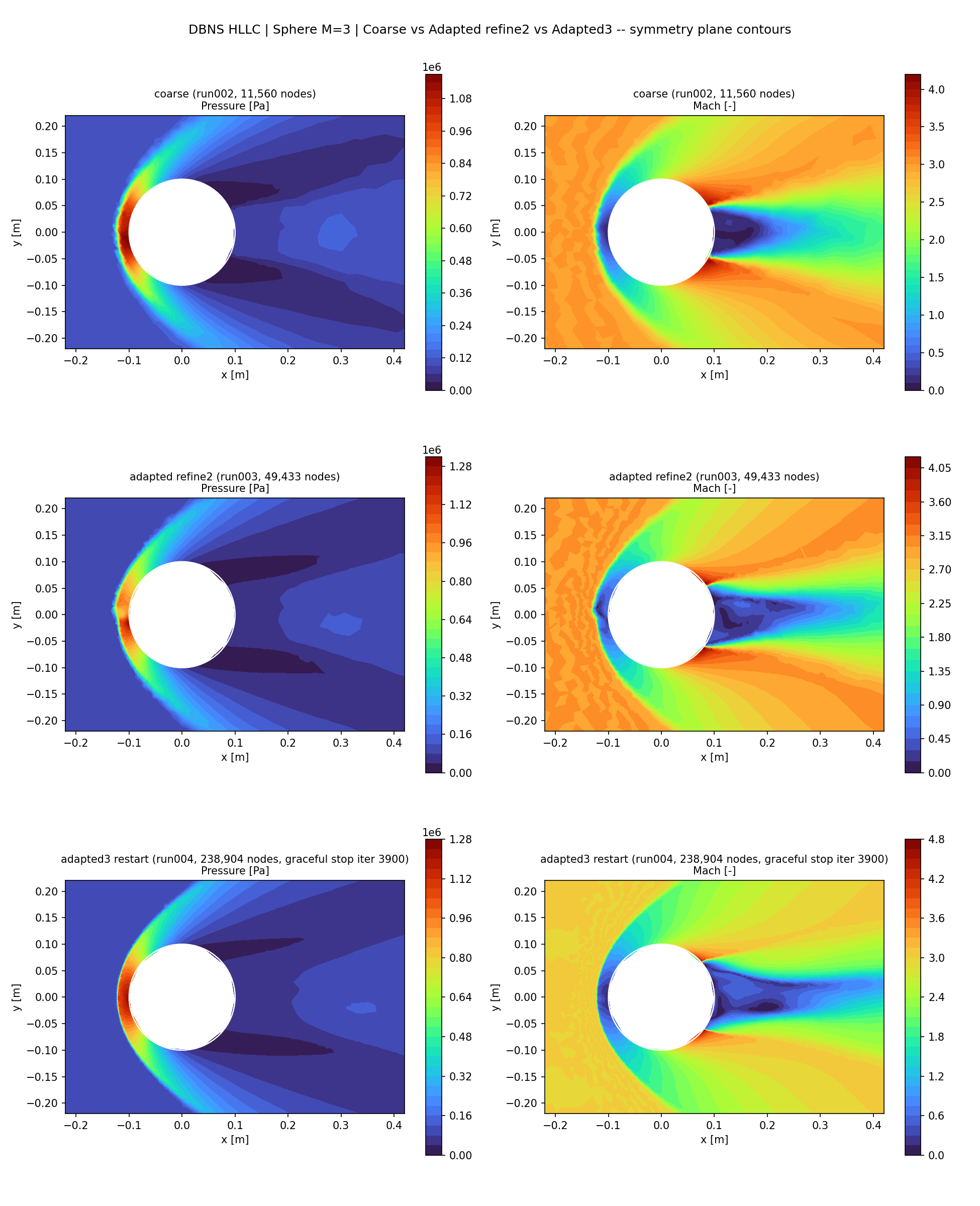
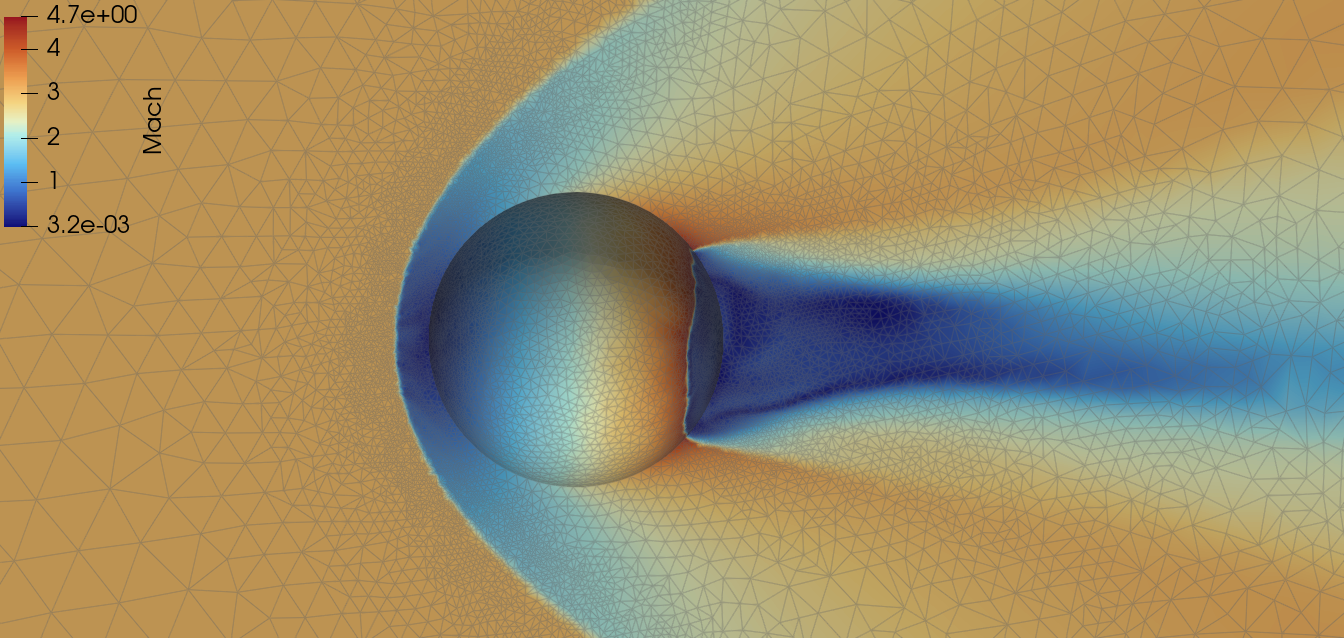
A clearly detached bow shock is reproduced at every mesh resolution, consistent with the expected qualitative feature of blunt-body supersonic flow:
Quantitative comparison against the Billig stand-off distance and the Rayleigh-Pitot stagnation pressure, along the stagnation streamline:
| Mesh | Nodes | Stand-off distance Δ |
Error vs. Billig | Stagnation pressure p₀,₂ |
Error vs. Rayleigh-Pitot |
|---|---|---|---|---|---|
| coarse | 11,560 | 23.18 mm | +13.1% | 1,102,994 Pa | −9.7% |
| adapt3 | 238,904 | 21.41 mm | +4.5% | 1,222,333 Pa | +0.0% |
| adapt4 | 656,764 | 21.73 mm | +6.0% | 1,200,418 Pa | −1.8% |
Refining from coarse to adapt3 (shock-band-targeted adaptive refinement) substantially reduces the error in both metrics, with the stagnation pressure converging to the theoretical value. A further refinement step (adapt3→adapt4) does not continue this trend — the error increases slightly rather than decreasing further, indicating that adapt3 is close to the practical resolution limit for this particular mesh sequence and quantity of interest, rather than errors decreasing monotonically without bound.
On the finest meshes (adapt3, adapt4), the density residual settles into a bounded oscillation rather than reaching the fully converged level obtained on the coarse mesh; integrated force coefficients and flow-field extrema were confirmed to settle to stationary values well before the run was stopped, and the reported stand-off distance and stagnation pressure are based on these settled states. The stand-off distance itself is resolved over only a few mesh cells (it is comparable in size to the local cell spacing near the shock even on the finest mesh), so its precise numerical value carries a meaningfully larger uncertainty than the stagnation-pressure comparison.
25.9 Conclusions and Applicable Scope
- Wake CFD’s 3D Euler solver reproduces a correctly detached bow shock with stand-off distance and stagnation pressure matching established correlations to within a few percent on a refined mesh (
Δ: +4.5%,p₀,₂: +0.0% at the best-resolved point in this sequence). - Refinement reduces error up to a point (
coarse→adapt3) but does not continue to do so indefinitely in this mesh sequence (adapt3→adapt4shows a small regression) — this result should be read as validation at the demonstrated resolution, not as evidence of unbounded grid convergence. - The stand-off distance comparison carries larger relative uncertainty than the stagnation-pressure comparison, because the shock stand-off distance is resolved over only a few mesh cells even on the finest mesh used.
- This result applies to inviscid, supersonic (
M=3), ideal-gas flow over a sphere at zero angle of attack. It does not establish accuracy for viscous (shock-boundary-layer interaction) effects, other Mach numbers, or non-spherical blunt bodies.
25.10 References
- Billig, F. S., “Shock-Wave Shapes Around Spherical- and Cylindrical-Nosed Bodies,” Journal of Spacecraft and Rockets, 4(6), 1967, pp. 822–823.