10 Forward-Facing Step — Supersonic Shock-System Verification
Qualitative comparison with the Woodward–Colella benchmark and a global mass-balance check
10.1 Run Provenance and Artifacts
| Item | Value |
|---|---|
| Wake CFD baseline version | 0.22.0 |
| Solver | DBNS |
| Compute device | CPU |
| Parallel execution | 1 MPI rank |
| Arithmetic precision | FP64 |
| Run date | 2026-08-20 |
Results depend on the solver build that produced them. Read every figure in this report together with the version and date above — re-running the same input on a later build may give different numbers.
10.1.1 Downloadable Files
Not available: standalone input decks and solver result files have not yet been published for download.
10.2 Verification Objective
This case evaluates Wake CFD on the classical Mach 3 forward-facing-step problem. Unlike the oblique-wedge case, this problem has no closed-form solution. Verification is therefore based on reproduction of the characteristic inviscid shock system reported in the benchmark literature, supplemented by a global mass-conservation check.
The case is based on the forward-facing-step problem of Emery and of Woodward and Colella.
10.3 Reference Solution and Data
10.3.1 Numerical Reference
The qualitative benchmark is the forward-facing-step flow described by Emery and by Woodward and Colella (see References). No pointwise reference dataset is reported here.
10.4 Simulation Conditions
| Item | Setting |
|---|---|
| Geometry | 2D channel, 3.0 × 1.0 m; step at x=0.6 m with height 0.2 m |
| Physics | Steady Euler equations, ideal-gas air (gamma=1.4) |
| Freestream | M=3.0, p=101325 Pa, T=288.15 K, zero angle of attack |
10.5 Mesh
| Item | Setting |
|---|---|
| Mesh | Unstructured triangular mesh; 53,565 nodes; rounded inside step corner |
10.6 Boundary and Initial Conditions
| Item | Setting |
|---|---|
| Wall | Free-slip inviscid wall |
| Inlet | Supersonic farfield inflow |
| Outlet | Supersonic pressure outlet; interior state extrapolated |
Initial field: Not reported.
10.7 Numerical Methods
| Item | Setting |
|---|---|
| Convective scheme | Roe with Harten–Hyman entropy fix |
| Spatial method | Green–Gauss gradients with Venkatakrishnan limiter |
| Time integration | Implicit, adaptive CFL ramp |
10.8 Results
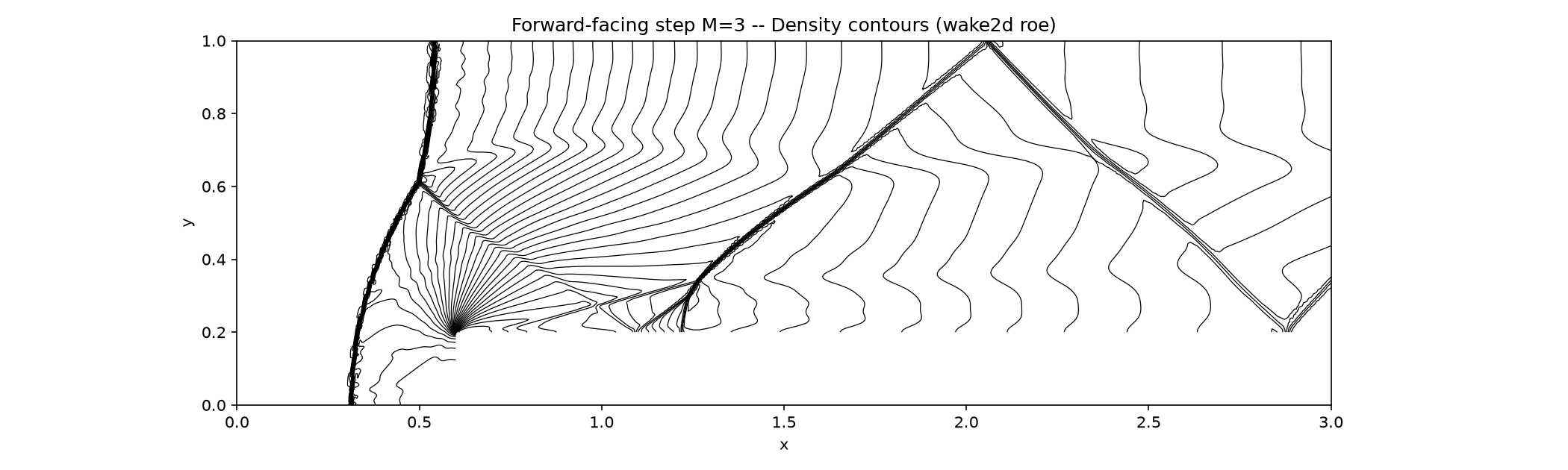
The density contours reproduce the benchmark’s characteristic features: a bow shock upstream of the step, an expansion fan at the step corner, a reflected shock from the upper wall, and a secondary reflection downstream.
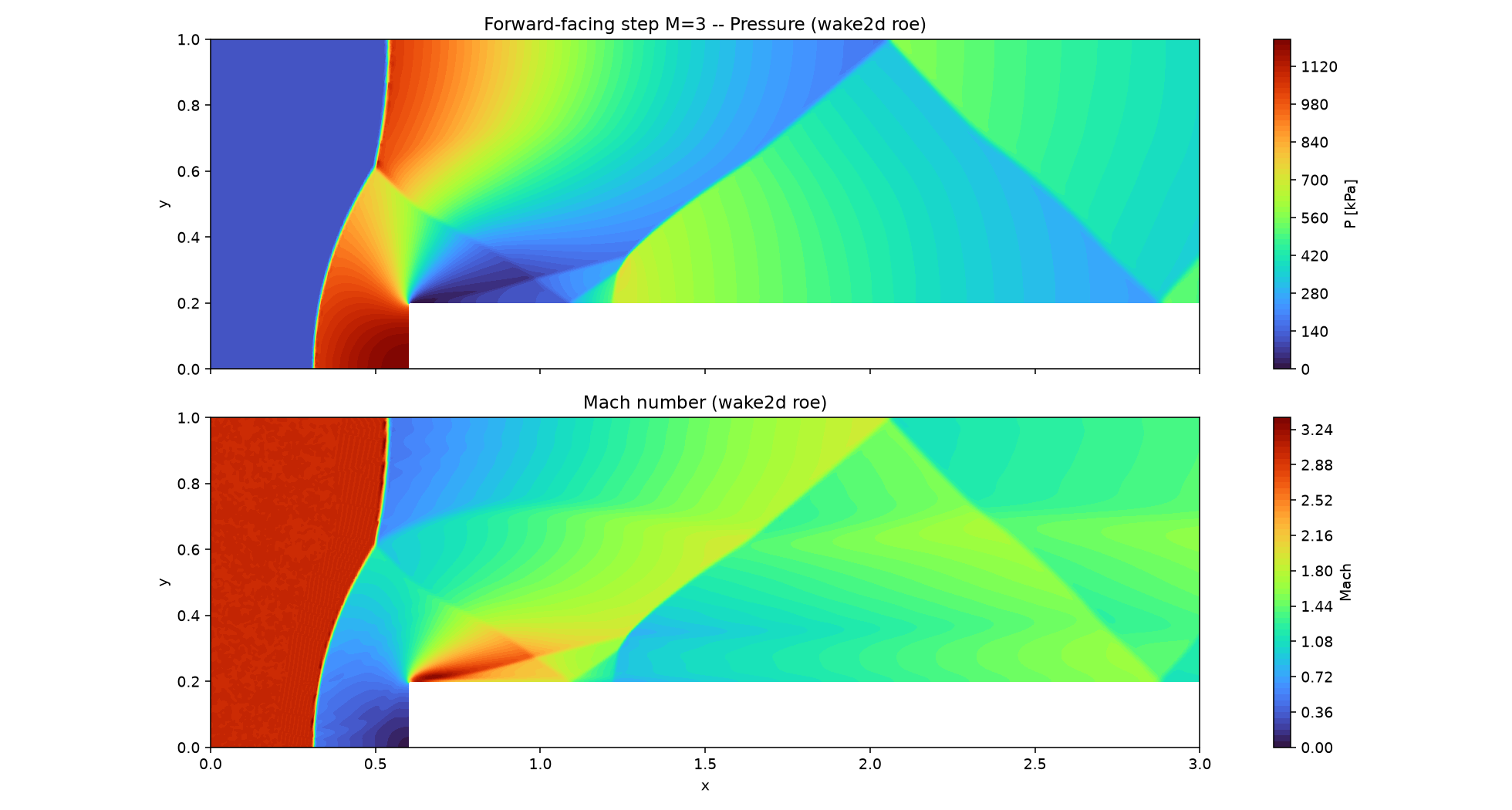
As a quantitative consistency check, the integrated inlet mass flow is approximately 1250.59 kg/(s·m) and the outlet mass flow is approximately 1250.94 kg/(s·m), excluding the blocked region below the step. The resulting mass-flow difference is 0.03%.
10.9 Conclusions and Applicable Scope
- The computed shock structure is qualitatively consistent with the established Woodward–Colella forward-facing-step benchmark.
- The global inlet/outlet mass-flow mismatch is 0.03% for the reported steady solution.
- This is a qualitative benchmark with a global conservation check, not a pointwise comparison with an analytical or experimental reference solution.
- The result is limited to steady, two-dimensional inviscid flow on the reported mesh. It does not establish mesh convergence, viscous-flow accuracy, or general scheme robustness.
10.10 References
- Emery, A. F., An Evaluation of Several Differencing Methods for Inviscid Fluid Flow Problems, Journal of Computational Physics, 2(3), 306–331, 1968.
- Woodward, P., and Colella, P., The Numerical Simulation of Two-Dimensional Fluid Flow with Strong Shocks, Journal of Computational Physics, 54(1), 115–173, 1984.