9 Supersonic Wedge — Oblique-Shock Verification
Comparison with the exact theta–beta–Mach and Rankine–Hugoniot relations
9.1 Run Provenance and Artifacts
| Item | Value |
|---|---|
| Wake CFD baseline version | 0.22.0 |
| Solver | DBNS |
| Compute device | CPU |
| Parallel execution | 1 MPI rank |
| Arithmetic precision | FP64 |
| Run date | 2026-08-20 |
Results depend on the solver build that produced them. Read every figure in this report together with the version and date above — re-running the same input on a later build may give different numbers.
9.1.1 Downloadable Files
Not available: standalone input decks and solver result files have not yet been published for download.
9.2 Verification Objective
This is a code-verification case, not an experimental validation case. The two-dimensional Euler solution over a 15° wedge is compared directly with the exact oblique-shock relations. It verifies shock capturing, inviscid wall treatment, and supersonic inflow and outflow boundary conditions.
The geometry and freestream condition reproduce the NASA GRC WIND verification case, Oblique Shock on a 15 Degree Wedge at Mach 2.5.
9.3 Reference Solution and Data
9.3.1 Analytical Solution
For an upstream Mach number M_1, wedge deflection theta, and specific-heat ratio gamma, the weak-shock angle beta is obtained from the theta–beta–Mach relation:
\[ \tan\theta = 2\cot\beta\; \frac{M_1^2\sin^2\beta-1}{M_1^2(\gamma+\cos2\beta)+2}. \]
The downstream state follows from the normal-shock Rankine–Hugoniot relations using M_1n=M_1\sin\beta. For M_1=2.5, theta=15°, and gamma=1.4, the reference values are:
| Quantity | Reference value |
|---|---|
Weak-shock angle, beta |
36.94490° |
Downstream Mach number, M_2 |
1.873526 |
Pressure ratio, p_2/p_1 |
2.467500 |
Density ratio, rho_2/rho_1 |
1.866549 |
Temperature ratio, T_2/T_1 |
1.321958 |
9.4 Simulation Conditions
| Item | Setting |
|---|---|
| Geometry | 2D wedge; 15° half-angle |
| Physics | Steady Euler equations, ideal-gas air (gamma=1.4) |
| Freestream | M=2.5, p=101325 Pa, T=288.15 K, zero angle of attack |
9.5 Mesh
| Item | Setting |
|---|---|
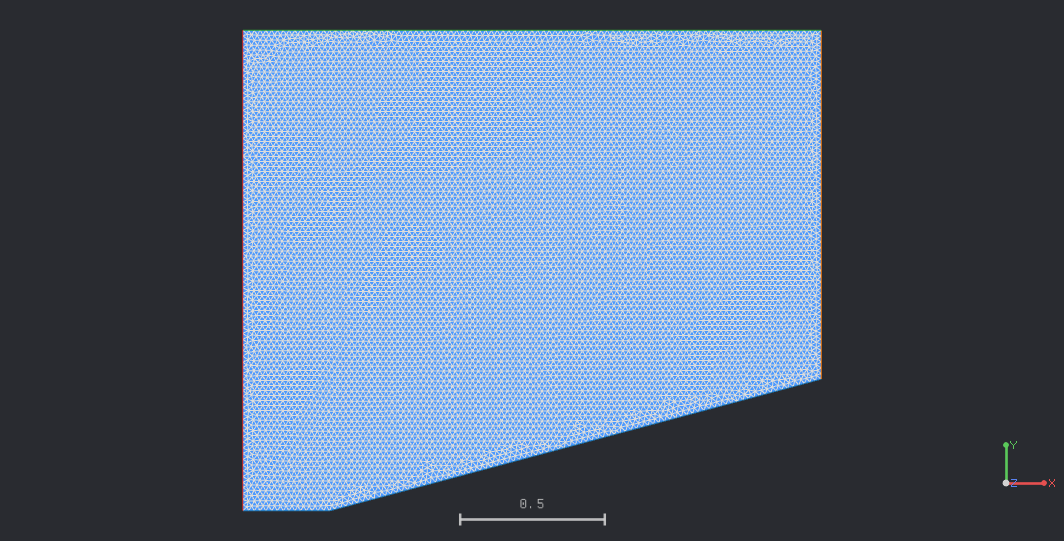
| Mesh | Unstructured triangular mesh; 8,789 nodes |
9.6 Boundary and Initial Conditions
| Item | Setting |
|---|---|
| Wall | Free-slip inviscid wall |
| Inlet | Supersonic farfield inflow |
| Outlet and top boundary | Supersonic pressure outlet; interior state extrapolated |
Initial field: Not reported.
9.7 Numerical Methods
| Item | Setting |
|---|---|
| Convective schemes | AUSM, AUSM+up2, AUSM+up, HLLC, JST, Roe, SLAU2, and SLAU (compared below) |
| Spatial method | Green–Gauss gradients with Venkatakrishnan limiter |
| Time integration | Implicit, adaptive CFL ramp |
9.8 Results
The Roe result captures the attached oblique shock and the uniform post-shock region expected for this inviscid flow.
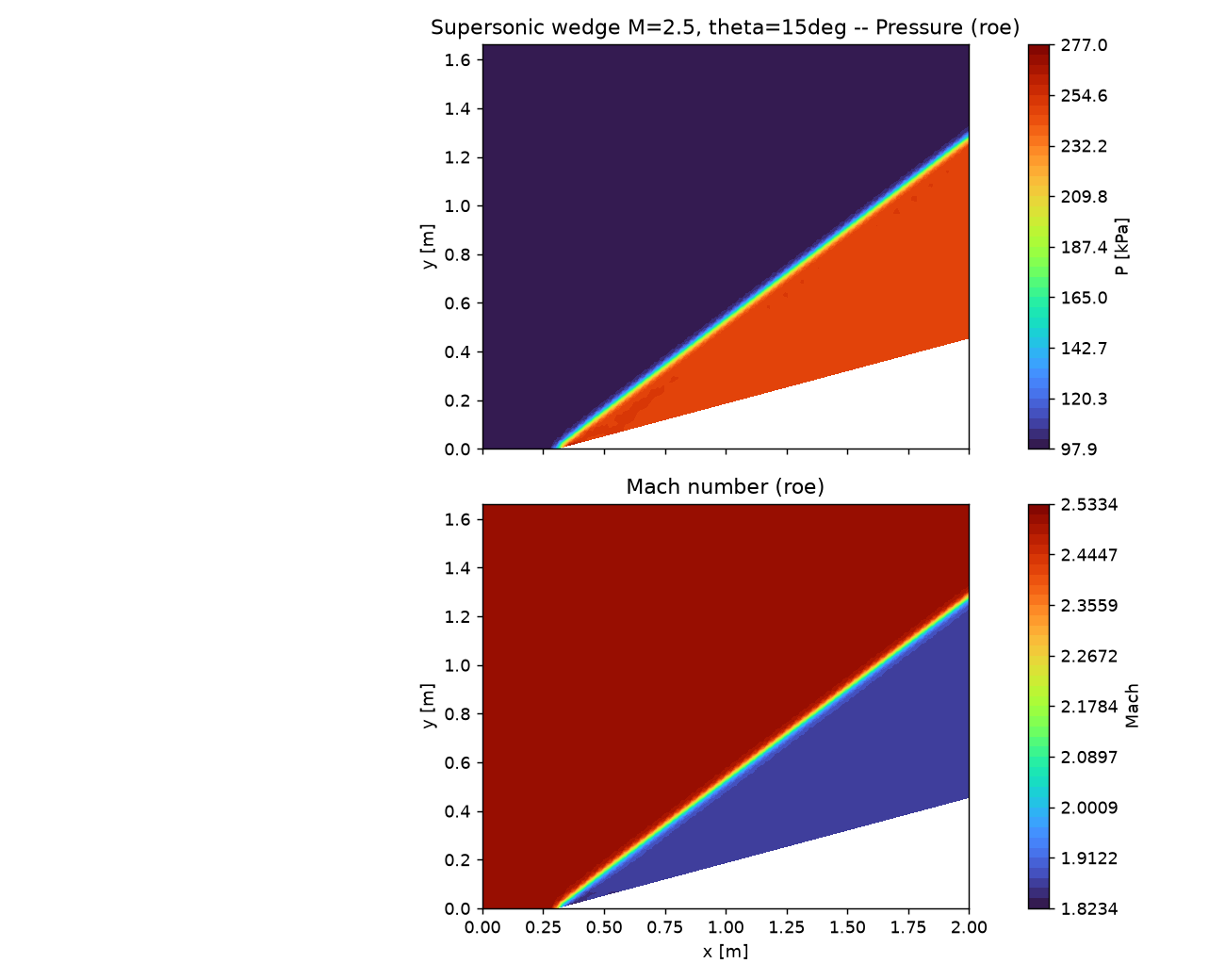
Eight convective schemes were evaluated on the same mesh and boundary conditions. All reached the specified convergence criterion. Post-shock values were sampled downstream of the shock and compared with the exact solution.
| Scheme | p_2/p_1 |
Error in p_2/p_1 |
M_2 |
Error in M_2 |
|---|---|---|---|---|
| AUSM | 2.46752 | +0.0008% | 1.86655 | −0.372% |
| AUSM+up2 | 2.46750 | −0.0001% | 1.86539 | −0.434% |
| AUSM+up | 2.46744 | −0.0025% | 1.86402 | −0.507% |
| HLLC | 2.46746 | −0.0017% | 1.86528 | −0.440% |
| JST | 2.46729 | −0.0086% | 1.87445 | +0.049% |
| Roe | 2.46749 | −0.0003% | 1.86451 | −0.481% |
| SLAU2 | 2.46747 | −0.0012% | 1.86295 | −0.564% |
| SLAU | 2.46744 | −0.0023% | 1.86152 | −0.641% |
The pressure-ratio error is below 0.01% for every scheme, and the downstream-Mach error is below 0.7%. This case is deliberately simple: its purpose is to verify the exact shock jump and boundary-condition treatment, not to differentiate scheme robustness for complex shock interactions.
9.9 Conclusions and Applicable Scope
- Wake CFD reproduces the exact pressure jump for the attached oblique shock to within 0.01% across the tested schemes.
- The downstream Mach number agrees with the exact solution to within 0.7%.
- These results apply to a single attached shock in steady, two-dimensional inviscid flow on one mesh. They do not establish accuracy for viscous effects, separated flow, shock interaction, or mesh convergence.