17 Reference values
Moment reference point, coefficient normalization, and Reynolds-number reporting
17.1 What this setting is
Reference values provide the geometric and velocity scales used to convert calculated forces and moments into coefficients designers can compare. Reference area, moment lengths, velocity, and moment origin must be defined consistently with the geometry and test conditions. They are not boundary conditions and do not define the operating state of the flow.
17.2 Configure in the GUI
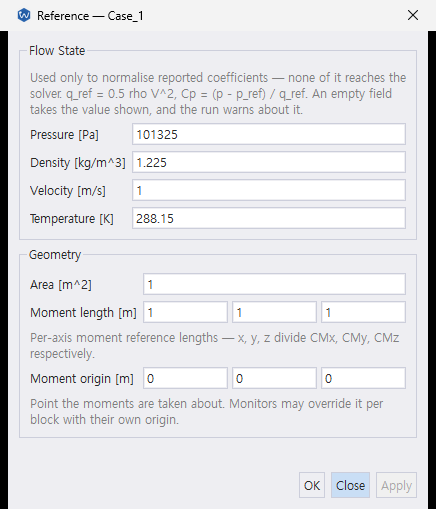
In the dialog, “does not reach the solver” means that these values do not replace the farfield, inlet, or initialization state and are not used as the flow nondimensionalization state. The numerical-scale exception for PBNS is described below.
17.3 Configure in JSONC
{
  "reference": {
    "origin_moment": [0.25, 0.0, 0.0],
    "length_moment": [1.0, 1.0, 1.0],
    "area": 1.0,
    "pressure": 101325.0,
    "temperature": 288.15,
    "density": 1.225,
    "velocity": 50.0
  }
}reference does not define the operating condition. The flow state used for boundary conditions and internal nondimensionalization is derived from the farfield, initialization, or inlet/outlet configuration, never from this block. If no operating condition can be established for a compressible, nondimensional run, the solver fails rather than falling back to reference with an implied Mach = 0.
reference: currently has these roles:
- Moment reference point and area —
origin_moment,length_moment, andareacompute force and moment coefficients (CL, CD, CMx/CMy/CMz). - Coefficient reference state — density and velocity define
q_ref = 0.5 ρ_ref V_ref²; pressure definesCp = (p − p_ref) / q_refand the pressure-force reference. - Thermal reference temperature — reserved for future Nu/St/HTC output.
Supply these values explicitly. Missing density, velocity, pressure, and temperature use fixed defaults of 1.225 kg/m³, 1 m/s, 101325 Pa, and 288.15 K and emit DefaultUsed warnings. Zero/unset no longer means freestream auto. To copy operating values, run wake_3d_mixed case.jsonc --validate --format json (use your case dimension; add .exe on Windows) and inspect operating_reference. Older GUI screenshots may show the former defaults.
An explicitly supplied reference.velocity also contributes to the DBNS low-Mach reference speed. The coefficient default does not supply this numerical scale; hovering rotors should specify a representative tip speed.
For steady PBNS with automatic pseudo-time stepping, max(reference.length_moment) and the maximum available flow or reference.velocity provide the numerical L/U time scale. This affects the convergence time scale, not the physical boundary condition.
17.4 Key definitions
| Key | Unit | Description |
|---|---|---|
origin_moment |
[x,y,z] m |
Moment reference point (coordinates for CMx/CMy/CMz) |
length_moment |
[Lx,Ly,Lz] m |
Per-axis moment reference length, normalizing CMx/CMy/CMz respectively. Aircraft convention: Lx = Lz = span, Ly = chord. |
area |
m² | Reference area (CL/CD denominator) |
pressure |
Pa | Reference pressure for Cp and pressure forces (≥ 0). |
temperature |
K | Reserved reference temperature for future Nu/St/HTC output. |
density |
kg/m³ | Positive coefficient reference density. |
velocity |
m/s | Positive coefficient reference velocity (the q_ref denominator). |
17.5 NACA0012 example (chord = 1 m)
{
  "reference": {
    "origin_moment": [0.25, 0.0, 0.0],
    "length_moment": [1.0, 1.0, 1.0],
    "area": 1.0,
    "pressure": 101325.0,
    "temperature": 288.15,
    "density": 1.225,
    "velocity": 50.0
  }
}
origin_moment is the quarter-chord by convention; length_moment’s Ly slot is the chord, and area is chord × unit span for this 2D case. The example uses a 50 m/s coefficient reference; it does not prescribe the flow velocity. Match density, pressure, and velocity to the intended freestream or other normalization convention.
17.6 Reynolds-number reporting (not input)
Reynolds number is not an input (R-006). It’s a post-processing value, computed fresh each time it’s printed rather than stored in the config:
Re_derived = ρ_∞ · V_∞ · L / μ_∞(Sutherland)
L = reference.length_moment[1]   (the Ly / chord slot, by convention)
To match a Reynolds number from a paper, select farfield.{P, T} and Mach (→ V) accordingly.